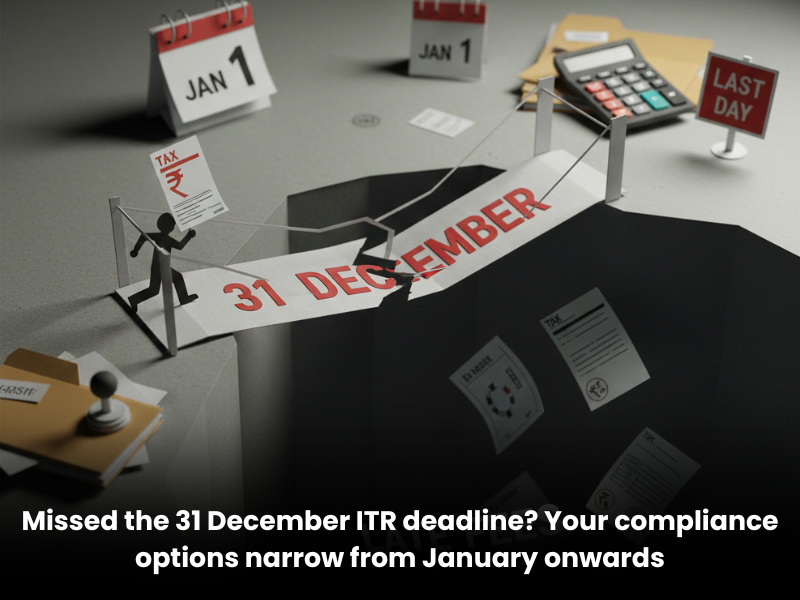
The 31 December deadline marks a critical cut-off for taxpayers who either missed the original return filing date or need to correct errors in a return already filed. Once this date passes, the belated and revised return windows close, and taxpayers are left with a more expensive and restrictive option: the updated return (ITR-U) under Section 139(8A) of the Income Tax Act.
Understanding the distinction between these options is important, because a delay of even a few days can materially increase tax cost, limit loss carry-forward, or eliminate refund eligibility.
What Changes After 31 December
Up to 31 December of the relevant assessment year, taxpayers have two relatively flexible options:
- Revised return for correcting errors in a timely filed return
- Belated return for those who failed to file within the original due date
From 1 January onwards, both options close. Any disclosure, correction, or filing must be done through an updated return, which is allowed for a longer period but comes with additional tax and restrictions.
Revised Return: For correcting errors in a timely filing
A revised return under Section 139(5) is available to taxpayers who filed their return on time but later identified errors or omissions. This has become increasingly relevant due to data mismatches between ITRs, Form 16, AIS, and foreign reporting systems.
Key points
- Can be filed multiple times, but only until 31 December or completion of assessment, whichever is earlier
- Replaces the original return completely
Penalty and interest
- No penalty merely for revising
- Interest applies only if tax remains unpaid
Losses and refunds
- Losses declared in the original return can be corrected and carried forward, provided the original return was filed within the due date
- Refunds can be claimed or corrected, subject to verification
For taxpayers who filed on time but received discrepancy alerts or discovered reporting errors, this is the least disruptive correction route.
Belated Return: For missed original deadlines
A belated return under Section 139(4) applies where the taxpayer did not file a return by the original due date.
Key points
- Can be filed only up to 31 December of the assessment year
- Once this date passes, belated filing is no longer permitted
Penalty and interest
- Late filing fee up to ₹5,000
- Capped at ₹1,000 if total income does not exceed ₹5 lakh
- Interest applies on any unpaid tax
Losses and refunds
- Losses can be set off against income in the same year
- Carry-forward of most losses, such as business or capital losses, is generally not allowed
- Refunds can be claimed, but processing may take longer
For taxpayers who missed the original deadline, 31 December is the final chance to limit compliance cost.
Updated Return (ITR-U): The only option after 31 December
From 1 January onwards, corrections or disclosures must be made through an updated return using Form ITR-U.
Key points
- Can be filed up to 48 months from the end of the assessment year
- Available even if no return was filed earlier
- Only one updated return per year is permitted
For example, for Assessment Year 2025–26, the outer deadline for filing an updated return extends up to 31 March 2030.
Cost and restrictions under ITR-U
While the window is longer, the updated return is not a neutral correction tool.
Additional tax
- 25% additional tax if filed within the first year
- 50% in the second year
- 60% in the third year
- 70% in the fourth year
Losses and refunds
- Cannot be used to create or increase losses
- Carry-forward of losses is not allowed
- Refund claims are not permitted
Once filed, the updated return must also be verified, and in certain cases may still attract further proceedings.
Who Should Be Particularly Careful
- Taxpayers expecting refunds, as delays may eliminate refund eligibility
- Those with capital gains or business losses, where carry-forward rights matter
- NRIs and globally linked taxpayers, especially with foreign asset disclosures
- Employees responding to mismatch notices, where timing determines whether revision or updation applies
Practical Takeaways
- If you have already filed a return and discovered errors, use the revised return option before 31 December
- If you missed filing entirely, file a belated return before the deadline to minimise penalties
- Do not treat ITR-U as a routine solution. It is designed as a last-resort compliance mechanism
- Delays reduce options and increase tax cost
Closing Note
Income tax returns are no longer simple tax computations. They are comprehensive disclosure statements, validated against multiple data sources.
The law provides correction mechanisms, but each comes with increasing cost and limitation as timelines pass. Acting before 31 December preserves flexibility, protects refunds, and avoids avoidable additional tax outgo.