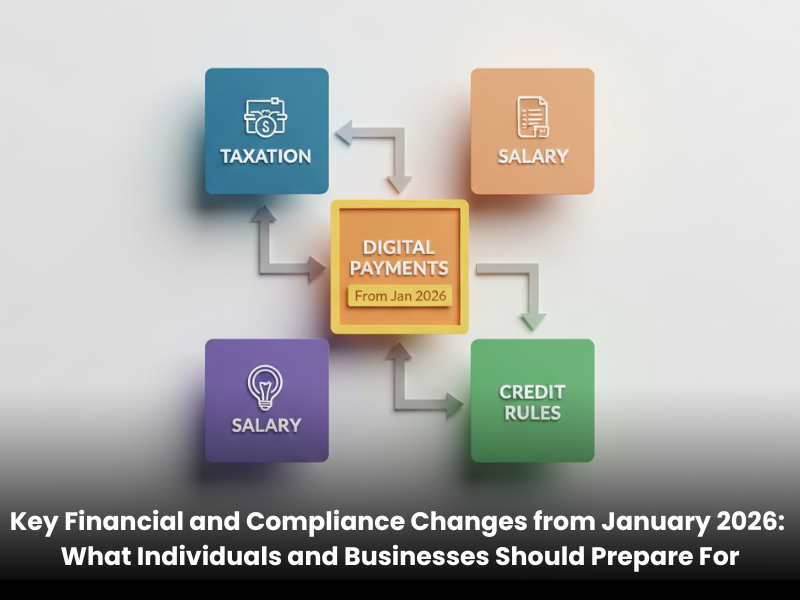
From 1 January 2026, a series of regulatory and financial changes will come into effect across taxation, employment compensation, banking, digital payments, and consumer finance. While none of these changes are disruptive in isolation, taken together they will affect government employees, salaried taxpayers, farmers, bank customers, and credit card users.
This note summarises the confirmed changes, outlines who is impacted, and highlights areas where early preparation can help avoid compliance or cost-related issues.
Employment, Pay and Provident Fund Changes
Eighth Pay Commission implementation
The Eighth Pay Commission will come into effect from 1 January 2026, replacing the Seventh Pay Commission, which concludes on 31 December 2025.
- Central government employees and pensioners can expect revisions in:
- Basic pay
- Dearness allowance (DA)
- Pension calculations
- Basic pay
- The revision is intended to account for inflation and wage realignment.
At present, exact pay matrices, fitment factors, and allowance revisions have not been notified. Any salary or pension projections circulating in the public domain should therefore be treated as indicative only.
Provident fund and salary alignment
Pay Commission changes typically have a downstream impact on:
- Provident fund contributions
- Gratuity calculations
- Leave encashment
- Pension commutation values
Employees nearing retirement should monitor notifications closely once detailed rules are issued.
Taxation and Income Tax Return Changes
Redesigned ITR framework from January 2026
From January 2026, the income tax filing framework is expected to move towards:
- More extensively pre-filled ITR forms
- Greater use of banking, investment, and transaction-level data
- Tighter system-driven validation at the filing stage
While this is expected to reduce manual errors, it also increases the importance of:
- Reconciling AIS, TIS, Form 26AS, and bank statements
- Ensuring accurate classification of income and disclosures
The emphasis will continue to shift from post-filing correction to pre-filing accuracy.
PAN–Aadhaar linkage enforcement
PAN–Aadhaar linking will be mandatory for accessing a wider set of:
- Banking services
- Government schemes
- Financial transactions
Failure to link PAN and Aadhaar may result in:
- Restrictions on bank accounts
- Ineligibility for refunds or benefits
- Denial of certain financial services
Individuals who have not completed the linkage should treat this as a priority compliance item.
Digital Payments and Banking Controls
Banks and payment platforms are expected to introduce:
- Enhanced UPI transaction monitoring
- Stricter verification for SIM-linked financial activity
- Additional checks on messaging platforms used for financial communication
These measures are aimed at fraud prevention and misuse control. Customers may notice:
- More frequent transaction alerts
- Temporary transaction holds in case of verification gaps
- Increased KYC-related communication from banks
Agriculture and Insurance-Linked Compliance
Farmer ID requirement for PM-Kisan
In certain states, including Uttar Pradesh:
- A unique farmer ID will be required to receive PM-Kisan instalments
- Absence of the ID may delay or block benefit payments
Farmers should ensure timely registration to avoid disruption in scheme benefits.
Crop insurance coverage expansion
Under the PM Kisan Crop Insurance Scheme:
- Crop losses due to wild animal damage will now be eligible for coverage
- Claims must be reported within 72 hours of the incident
Timely reporting and documentation will be critical for claim eligibility.
Credit Card and Consumer Banking Changes (January–February 2026)
Several banks are revising credit card and debit card benefits.
SBI Card
- Introduction of a new domestic airport lounge access programme from 10 January 2026
- Access criteria and usage rules will change compared to existing programmes
HDFC Bank
- Transition to a voucher-based lounge access system for debit cardholders
- Revised minimum spend requirements to qualify for lounge benefits
ICICI Bank
Between January and February 2026, ICICI Bank will implement multiple changes, including:
- Caps on reward points for mid-tier and premium cards
- Revised fees on add-on cards
- Changes to movie benefits, including:
- Minimum quarterly spend thresholds
- Discontinuation of BookMyShow benefits on select cards from February
- Minimum quarterly spend thresholds
- A 1 percent fee on certain high-value transportation transactions
- Additional charges on:
- Online gaming transactions
- Large third-party wallet top-ups
- Select add-on card usage
- Online gaming transactions
These changes are aimed at aligning rewards with spending patterns and managing benefit costs.
What Individuals and Businesses Should Do Now
- Government employees should track Pay Commission notifications before making salary or retirement decisions
- Taxpayers should prepare for increased pre-filled data and strengthen reconciliation processes
- Bank customers should review updated credit card terms and reassess card usage patterns
- PAN–Aadhaar linkage should be completed without delay
- Farmers should ensure compliance with new ID and claim-reporting requirements
What Is Still Pending
- Detailed Pay Commission recommendations and implementation rules
- Final specifications of the redesigned ITR framework
- Bank-specific operational guidelines for revised card benefits
Until formal notifications are issued, planning should be based on confirmed rules rather than projections.
Closing Note
January 2026 marks a broad compliance and policy reset across multiple financial touchpoints. While most changes are incremental, their combined effect increases the importance of timely compliance, accurate disclosures, and periodic review of financial arrangements.
Early preparation will help reduce friction, avoid avoidable costs, and ensure continuity of benefits and services.