Indian startups are entering a different phase.
The past few years were about testing ideas, chasing growth, and proving adoption.
2026 looks like the year those experiments harden into systems.
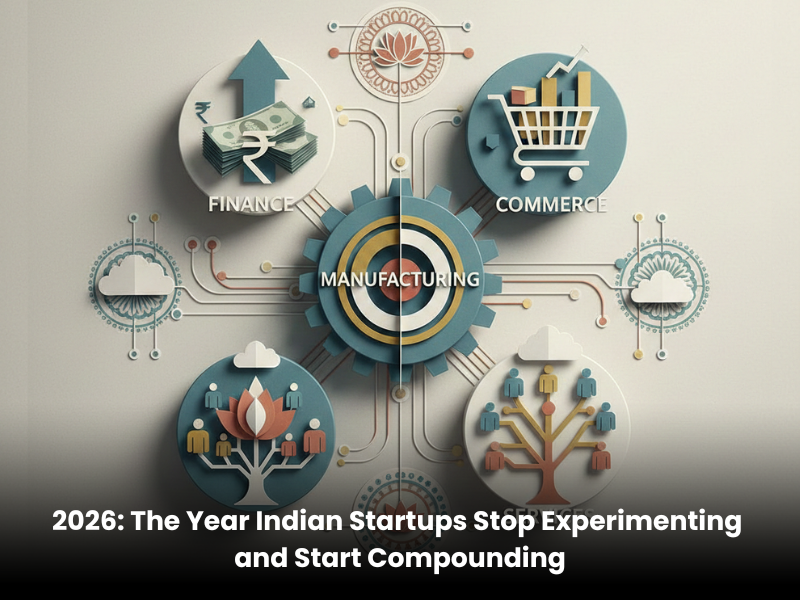
Across finance, manufacturing, commerce, and services, a few clear shifts are emerging. They are not trends in isolation. They are connected changes driven by data depth, AI maturity, and India’s unique market structure.
Here are the signals that matter.
1. India’s next wave is being built for Bharat, not “users”
The success of UPI solved one hard problem: trust and payments at scale.
The next problem is relevance.
AI layered on top of India’s digital public infrastructure is enabling products that work in local languages, varied literacy levels, and non-linear user journeys. Education, healthcare, finance, entertainment, and legal services are being redesigned for how Bharat actually consumes information.
This is not about inclusion as a slogan.
It is about unlocking large profit pools that were previously inaccessible because distribution and monetisation were broken.
Now they are not.
2. Finance is shifting from segmentation to individualisation
Indian financial services spent years classifying customers into buckets.
AI changes that.
With consent-led data flows via the Account Aggregator framework, lenders and financial platforms now have access to longitudinal financial behaviour. In 2026, that data starts getting used meaningfully.
The result is finance that adapts to the individual:
- Loans priced dynamically
- Nudges triggered by context, not campaigns
- Products assembled, not sold
The idea of a “relationship manager for every Indian” moves from metaphor to system.
3. Distribution economics in finance are breaking
Customer acquisition in finance is expensive, inefficient, and saturated.
AI is becoming the new distribution layer.
Platforms that embed intelligence into spending, credit, and rewards are reducing acquisition costs while increasing lifetime value. The differentiation is no longer brand or pricing alone, but how well the system understands and responds to behaviour.
Distribution is shifting from persuasion to precision.
4. AI is moving from the interface to the engine room
The first wave of AI in BFSI focused on chat and support.
That ceiling has been reached.
The next efficiency gains sit in underwriting, claims processing, collections, reconciliation, and compliance. These workflows determine margins, not marketing.
In 2026, AI starts reshaping the middle office, where costs live and scale breaks.
5. Fraud, risk, and compliance are now growth constraints
Fraud losses have grown sharply, and the nature of fraud has changed.
It is faster, more networked, and more automated.
This pushes fraud detection, AML, and risk monitoring from being back-office functions to core business capabilities. AI is being used not just to flag anomalies, but to map behaviour patterns, detect mule networks, and intervene early.
The motivation is simple: every prevented fraud directly protects margins.
6. CFO-grade decision-making comes to small businesses
India’s small and medium businesses run on thin margins and limited visibility.
That is starting to change.
AI-powered finance tools are automating bookkeeping, reconciliation, forecasting, tax, and treasury functions. What once required experienced finance teams is becoming accessible as software.
For India’s tens of millions of SMBs, this is not convenience.
It is a structural upgrade in how decisions are made.
7. AI is moving from conversation to execution
2025 taught AI how to speak.
2026 is about getting work done.
Computer-use agents are beginning to operate inside real systems: ERPs, CRMs, spreadsheets, and internal tools. These agents do not just recommend actions. They perform them.
This is where productivity shifts from incremental to material.
8. India becomes the global execution layer for AI
As AI adoption moves from demos to deployment, implementation becomes the bottleneck.
Integrating models into workflows, aligning them with compliance requirements, and adapting them to domain-specific logic is hard. This is where India’s services DNA becomes relevant again, in a new form.
Forward-deployed engineers, AI implementation specialists, and AI-as-a-service models are emerging as the next export engine.
The moat is no longer algorithms. It is execution depth.
9. Indian founders are building for global markets by default
India is no longer a stepping stone market.
It is a stress test.
Products that survive Indian price sensitivity, scale demands, and operational complexity are inherently resilient. With AI flattening access to technology and global supply chains rebalancing, Indian startups are increasingly global from day one.
SaaS led this shift. Consumer, B2B, and manufacturing are following.
10. Manufacturing is moving from cheap to credible
Indian manufacturing is changing character.
Cost competitiveness remains important, but global buyers now expect design capability, engineering depth, quality consistency, and compliance readiness. Indian firms are responding by upgrading skills, processes, and technology.
The pitch is no longer “we are cheaper”.
It is “we are reliable”.
11. AI enters the factory floor
AI is no longer confined to dashboards and reports.
It is being applied to sourcing, inventory planning, pricing, quality control, and demand forecasting. When AI connects operations with supply and demand in real time, cycle times shrink and waste reduces.
Factories start producing smarter, not just faster.
12. Consumer commerce is being re-architected
AI is dismantling the traditional commerce funnel.
Discovery is becoming conversational and personalised.
Advertising is increasingly tied directly to conversion.
Fulfilment is optimised based on demand signals, not forecasts alone.
Commerce is shifting from broadcast to relevance-driven systems.
13. Speed becomes the organising principle
India’s consumer behaviour has reset.
Whether it is groceries, healthcare, logistics, or services, “fast enough” is no longer acceptable. Markets that were informal and fragmented are getting organised through quick-commerce models.
This is not just about delivery time.
It is about trust, predictability, and scale.
Brands that once took years to build distribution can now scale in months.
Closing thought
2026 is not about flashy breakthroughs.
It is about compounding.
AI is moving into the core of businesses.
India’s market complexity is becoming an advantage.
And the winners will be those who stop experimenting and start building durable systems.
The headlines will come later.
The signals are already here.