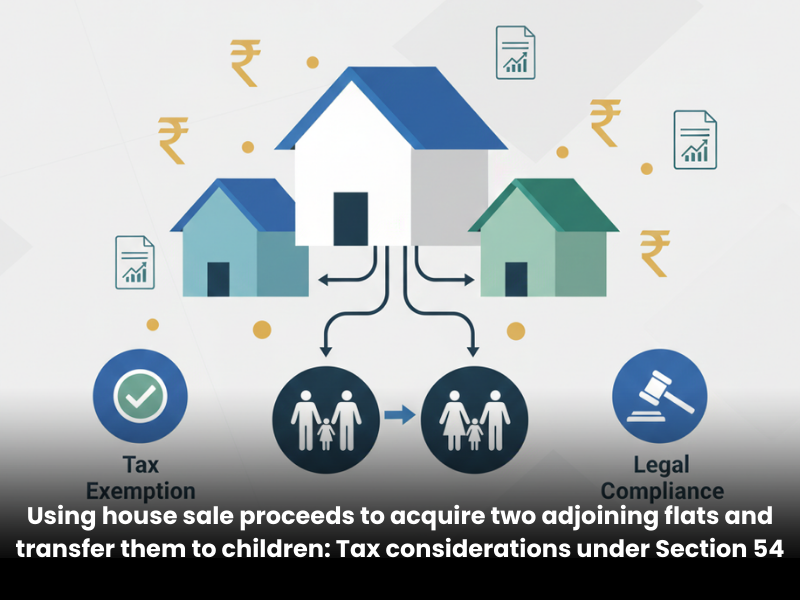
Taxpayers often look to reinvest the proceeds from the sale of a residential house into new property while minimizing capital gains tax and planning succession for their children. A common question is whether two adjoining flats can be purchased using the sale proceeds, and whether such property can later be passed to children without tax implications.
The answer lies in a careful application of Section 54 of the Income Tax Act, judicial precedents, and estate planning principles. When structured correctly, this approach can achieve both tax efficiency and smooth inter-generational transfer.
What Section 54 Allows
Section 54 provides exemption from long-term capital gains (LTCG) arising from the sale of a residential house, subject to conditions.
Key points:
- The house sold must be a long-term capital asset (held for more than 24 months).
- Only the long-term capital gains, not the entire sale consideration, need to be reinvested.
- The investment must generally be made in one residential house property in India, within the prescribed timelines.
This distinction between sale proceeds and capital gains is important. Many taxpayers assume the entire sale value must be reinvested, which is not the case.
Can Two Adjoining Flats Qualify as “One House”?
While the law refers to “one residential house”, courts and tribunals have, in multiple cases, taken a practical view.
Judicial principles that have emerged:
- If two or more adjoining flats are:
- Located in the same building or complex, and
- Used together as a single residential unit,
- Located in the same building or complex, and
- they may be treated as one residential house for the purposes of Section 54.
This interpretation has been accepted where the intention and actual use is that of a single dwelling, and not independent residential units.
However, this is a fact-based position, and documentation and usage should clearly support the claim.
Investment in Joint Names with Children
A frequent concern is whether adding children as co-owners affects the exemption.
From a tax perspective:
- The Section 54 exemption is linked to who makes the investment, not necessarily whose name appears on the title.
- You may purchase the new property in joint names with your son or daughter, even if:
- The entire investment is funded by you, and
- The children do not contribute financially.
Tribunal decisions have generally allowed Section 54 benefit in such cases, provided the capital gains are invested by the original seller.
That said, the source of funds and ownership intent should be clearly documented.
Passing the Property to Children Without Tax
For succession planning:
- Inheritance is not treated as a taxable transfer under the Income Tax Act.
- Property received by children through a will or by succession does not attract capital gains tax at the time of inheritance.
Accordingly:
- You may bequeath the house property to your children through a will.
- Your children will not pay tax merely because they inherit the property.
- Capital gains tax will arise only if and when they sell the property in the future, based on applicable rules at that time.
A properly drafted will helps avoid disputes and ensures smooth transfer.
Special Provision: Investment in Two Residential Houses
Section 54 also contains a specific, once-in-a-lifetime relaxation:
- If the long-term capital gains do not exceed ₹2 crore, the taxpayer may opt to invest in two residential houses instead of one.
- This option can be exercised only once in a lifetime.
This provision is separate from the “single residential unit” interpretation for adjoining flats and should be used carefully after evaluating long-term implications.
What Taxpayers Should Be Careful About
- Ensure the adjoining flats are genuinely used as one residential unit, not rented or used separately.
- Maintain clear documentation showing that capital gains were invested by you.
- Be cautious in exercising the once-in-a-lifetime two-house option, as it cannot be reversed.
- Execute a proper will rather than relying solely on joint ownership for succession.
Closing Note
Section 54 offers flexibility, but it operates within defined boundaries shaped by statutory language and judicial interpretation. Buying two adjoining flats, holding them jointly with children, and passing them on through inheritance can be tax-efficient if structured correctly. Given the value involved and the fact-specific nature of such claims, professional advice at the planning stage is advisable to ensure compliance and reduce the risk of future disputes.