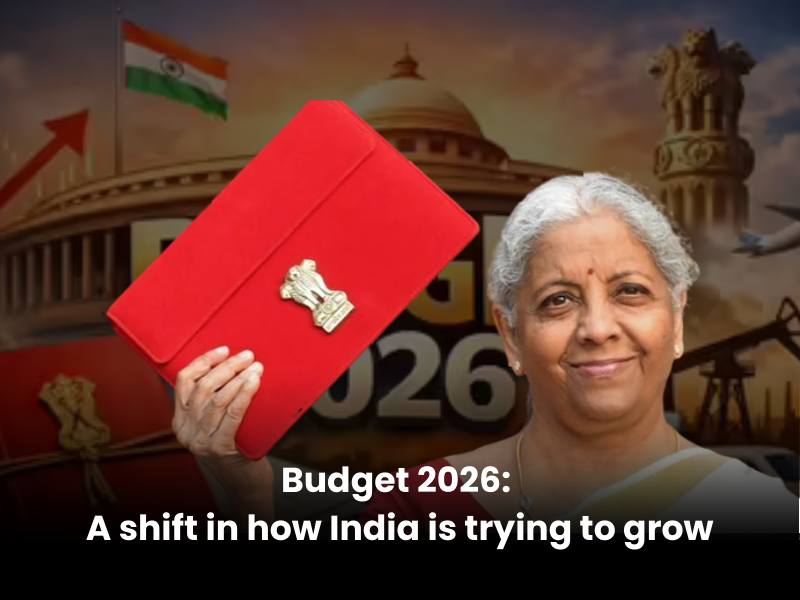
Budget 2026 does not read like a relief package. It reads like a design document for how the Indian economy is expected to scale over the next decade.
At first glance, it looks like a familiar mix of sector schemes and policy missions. But beneath the surface, the direction is clear: growth is no longer being chased through short-term demand boosts. It is being engineered through capacity, supply chains and productivity.
The state is no longer trying to move money faster. It is trying to build systems that last.
1. Capital expenditure as the main growth lever
The Centre has raised capital expenditure to a record ₹12.2 lakh crore.
This is not just about stimulus. It is about physically expanding the economy’s ability to produce, move and export. Roads, rail, logistics parks, industrial corridors and power networks are now the backbone of growth.
Sectors tied to this cycle—steel, cement, EPC, logistics, capital goods and industrial services—stand to benefit as public investment pulls private capital into long-gestation projects.
2. Securing strategic supply chains
The Budget places a clear bet on owning more of the value chain in sectors where India is currently dependent on imports or geopolitically exposed.
- Semiconductor Mission 2.0: ₹40,000 crore to support not only chip fabrication, but also equipment, materials and domestic IP
- Rare Earth Corridors: hubs in Odisha, Kerala, Andhra Pradesh and Tamil Nadu for mining, processing and research
- Tax holiday for cloud data centres till 2047: aimed at attracting global data and AI infrastructure
This is about reducing strategic vulnerability. In a world where technology supply chains are increasingly politicised, India is trying to secure its own choke points rather than remain dependent on external ones.
3. Healthcare and biotech as industrial sectors
Two announcements point to a shift in how healthcare is being treated:
- Biopharma Shakti: ₹10,000 crore for research in cancer, diabetes and autoimmune diseases
- Customs duty removed on 17 cancer drugs
Healthcare is no longer positioned only as welfare. It is being developed as a research-driven manufacturing sector, with the potential to export therapies, formulations and intellectual property.
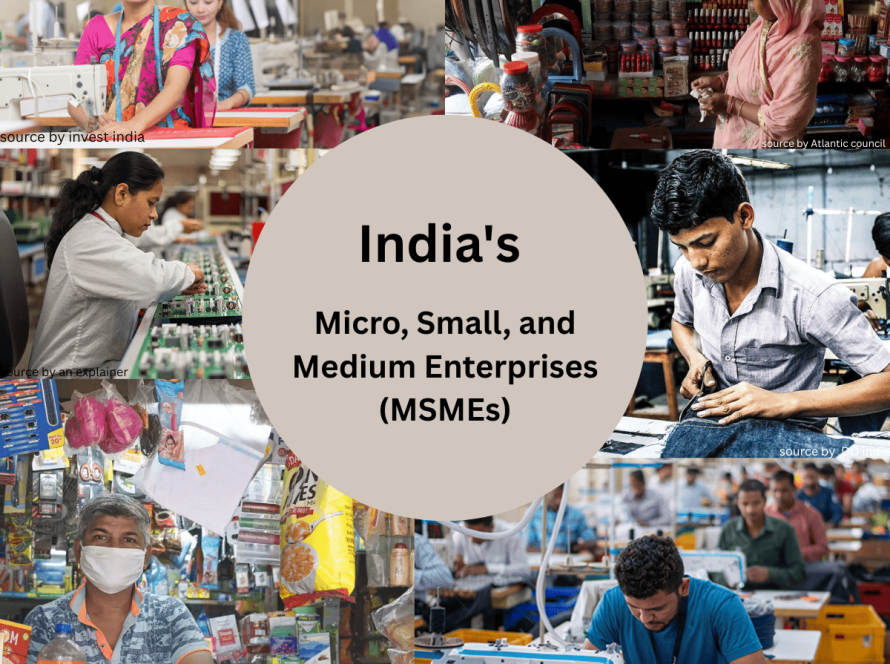
4. Structural support for MSMEs
Instead of scattered subsidies, the Budget introduces long-horizon capital and ecosystem support:
- ₹10,000 crore SME Growth Fund
- Revival of 200 legacy industry clusters
- ₹2,000 crore top-up to the Self Reliant India Fund
The intent is to reduce MSMEs’ dependence on bank credit alone and improve access to patient risk capital that allows them to scale, modernise and formalise.
5. Climate policy through balance sheets
The government has committed ₹20,000 crore over five years for carbon capture, utilisation and storage (CCUS).
This allows carbon-heavy sectors such as steel, cement and refining to remain globally competitive while decarbonising. Climate transition is being framed as a financial decision that impacts margins, exports and cost of capital, not only as a regulatory obligation.
6. Human capital as productive infrastructure
Two announcements reflect this shift:
- Five large education townships across states
- One government-supported girls’ hostel in every district
Education, housing and mobility are being treated as economic inputs. The focus is on enabling workforce participation, migration and skill formation, not just social outcomes.
7. Linking transport, tourism and rural growth
Seven high-speed rail corridors, tourism development, irrigation for 500 reservoirs, fisheries upgrades and high-value crops form a single geographic growth strategy.
The objective is to create region-linked economic clusters and reduce over-reliance on a handful of urban centres.
8. Fiscal anchors remain in place
Despite higher spending:
- Fiscal deficit targeted at 4.3% of GDP
- Debt-to-GDP projected to improve to 55.6%
This protects India’s macro credibility and limits the cost of government borrowing at a time of global capital volatility.
9. Tax and market adjustments
Key changes include:
- STT on futures raised to 0.05%
- Share buybacks taxed as capital gains
- Staggered ITR deadlines
- Net tax receipts projected at ₹28.7 lakh crore
These changes prioritise tax consistency and system stability, even if they raise near-term transaction costs.
Assessment
Budget 2026 is not designed to spark a short-term growth surge. It is designed to reshape how growth is generated.
The emphasis is on capacity, resilience and productivity—on changing the engine, not just pressing the accelerator.