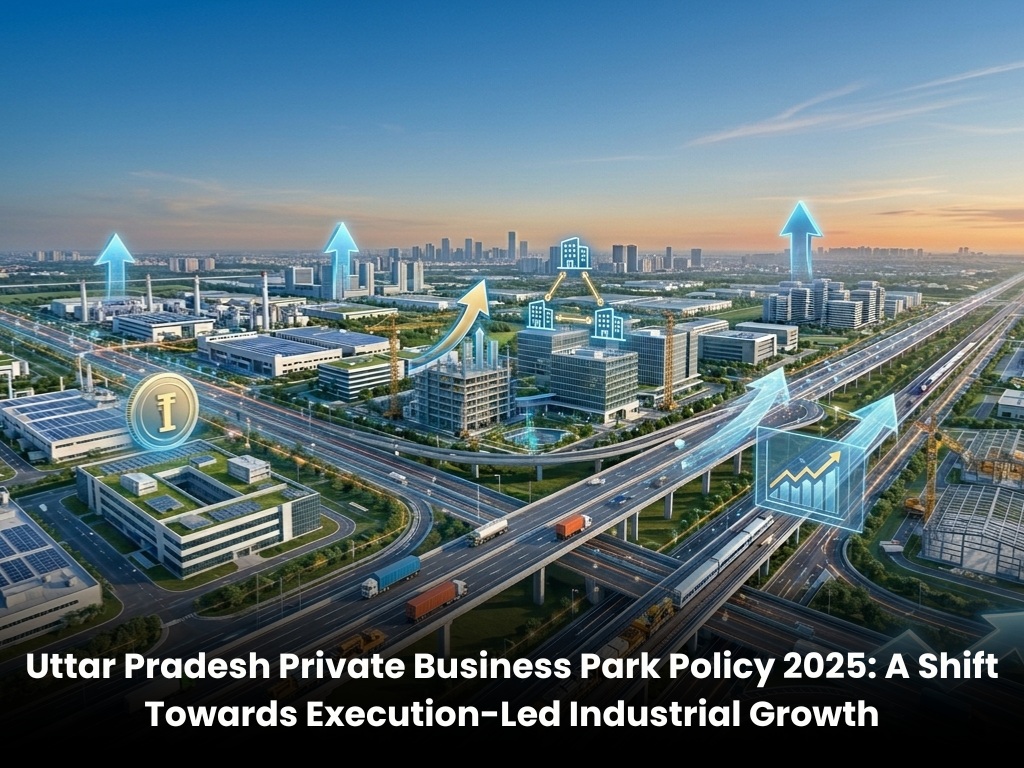
India’s industrial policy focus is increasingly moving from announcements to execution, and Uttar Pradesh appears to be aligning with this shift. The proposed Uttar Pradesh Private Business Park Development Scheme 2025 is positioned as an effort to accelerate industrial activity by enabling private participation in infrastructure creation.
At a time when states are competing to attract investments, the emphasis is no longer only on incentives but on the readiness of infrastructure. This is where the proposed scheme becomes relevant, especially for businesses looking to expand operations with lower execution delays.
A Private-Led Model for Industrial Infrastructure
Unlike traditional industrial policies, where the government develops industrial areas, this scheme places private developers at the centre. The state’s role is expected to remain facilitative, providing policy support, approvals, and an enabling framework, while actual development of business parks will be undertaken by private players.
This model signals a shift towards faster execution. Private developers, driven by commercial incentives, are often better positioned to deliver time-bound infrastructure compared to purely government-led projects.
Focus on Integrated Business Parks
The core idea behind the policy is to create well-planned business parks where multiple industries, ranging from MSMEs to large enterprises, can operate within a single ecosystem.
These parks are expected to provide essential infrastructure such as internal roads, power supply, water, and digital connectivity. The objective is to reduce the friction businesses typically face in setting up operations, particularly around land acquisition and basic infrastructure readiness.
For businesses, this translates into lower setup time and improved operational efficiency from day one.
Lowering Entry Barriers for MSMEs and New Businesses
One of the more practical outcomes of such a framework is its impact on small and medium enterprises.
For MSMEs, the biggest challenge is not always capital, but execution, identifying land, securing approvals, and arranging infrastructure. By offering ready-to-develop or pre-developed business parks, the scheme can significantly reduce these entry barriers.
This also creates a level playing field where smaller enterprises can operate alongside larger companies within the same ecosystem, benefiting from shared infrastructure and proximity to supply chains.
Investment Attraction and Economic Positioning
From a broader perspective, the scheme is designed to strengthen Uttar Pradesh’s position as an investment destination.
With multiple states actively competing for domestic and global capital, the availability of organised industrial infrastructure becomes a key differentiator. Business parks developed under a structured policy framework can improve investor confidence, particularly for companies evaluating large-scale or long-term investments.
If implemented effectively, the scheme could contribute to increased capital inflows, expansion of industrial activity, and improved employment generation across regions.
Minimum Scale and Developer Participation
The policy is expected to set a minimum land requirement, typically in the range of 10 to 25 acres or more, for developers to establish business parks. This ensures that projects are developed at a meaningful scale, allowing for proper planning and infrastructure integration.
For developers, this opens up an opportunity to participate in industrial infrastructure as an asset class. With rising demand for organised industrial spaces, especially in logistics and manufacturing, such developments can generate long-term value.
Execution Advantage: Time-to-Market as a Key Factor
One of the underlying objectives of the scheme is to reduce time-to-market for businesses.
In many cases, project delays are driven by fragmented processes, where land acquisition, approvals, and infrastructure setup occur sequentially. By integrating these elements within a single framework, the scheme aims to compress timelines and improve project viability.
For businesses, faster execution directly impacts revenue cycles, capital efficiency, and overall return on investment.
Potential Multiplier Effects
Industrial infrastructure projects tend to create spillover effects beyond direct manufacturing output.
The development of business parks can lead to increased demand for logistics, warehousing, and ancillary services. It can also generate local employment and support regional economic development, particularly in areas that are not yet fully industrialised.
Over time, such clusters can evolve into self-sustaining economic zones with integrated supply chains.
The Role of Policy and Governance
While the design of the scheme indicates a move towards private participation and execution efficiency, its success will depend on implementation.
Key factors will include clarity in approvals, coordination between departments, and ease of doing business at the ground level. Digital platforms such as Nivesh Mitra and similar initiatives may play a role in streamlining processes.
For investors and businesses, policy intent is important, but execution will ultimately determine outcomes.
Conclusion
The Uttar Pradesh Private Business Park Development Scheme 2025 is a reflection of the general trend in industrial policies that have shifted from allocation to execution.
The scheme, which allows for the construction of industrial ecosystems by private developers, is a way to solve some of the perennial problems associated with infrastructure readiness.
The benefits to businesses will be faster and more efficient business set-up and scalability.
The key to success for stakeholders will be in the evaluation and strategic participation of the policies and not in the decision-making process.