
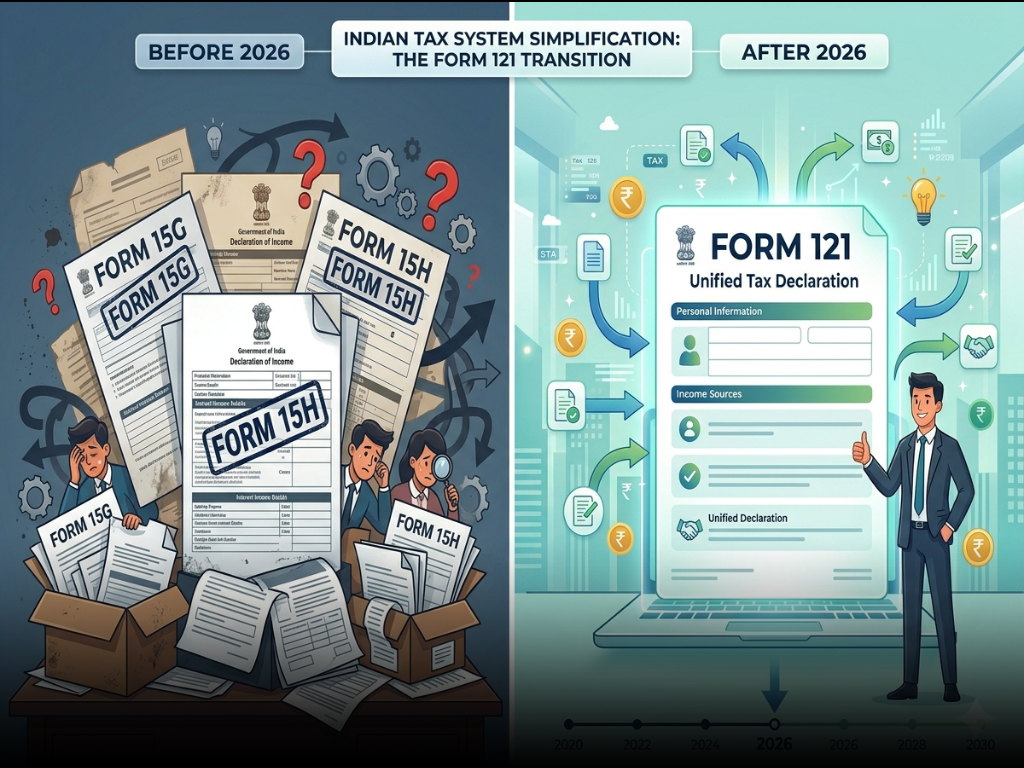
India’s tax system is undergoing a major simplification in 2026 – and if you earn interest income or want to avoid unnecessary TDS, this update is crucial for you.
From 1st April 2026, the government is introducing Form 121, a single unified declaration that replaces both Form 15G and Form 15H.
But what does this change actually mean for taxpayers, especially senior citizens? Let’s break it down in the simplest way possible.
What is Form 121?
Form 121 is a self-declaration form that allows individuals to inform banks or financial institutions that:
- Their total income is below the taxable limit
- Their final tax liability is NIL
This ensures that TDS (Tax Deducted at Source) is not deducted from their income.
Why Was Form 121 Introduced?
Earlier, taxpayers had to choose between:
- Form 15G → For individuals below 60
- Form 15H → For senior citizens (60+)
This created confusion and unnecessary complexity.
Now, Form 121 removes this confusion completely by introducing a single, age-neutral form for everyone.
✔ Key Objective:
- Simplify tax compliance
- Reduce errors in TDS declaration
- Make the system more user-friendly
Form 121 vs Form 15G & 15H (Key Differences)
| Feature | Old System (15G/15H) | New System (Form 121) |
| Number of Forms | Two separate forms | One single form |
| Age Criteria | Required | Not required |
| Complexity | High confusion | Simple & unified |
| PAN Requirement | Optional in some cases | Mandatory |
| Filing Details | More technical | Simplified format |
The biggest advantage: No more confusion about which form to use.
Who Can Use Form 121?
You can submit Form 121 if:
✔ Your total annual income is below the basic exemption limit (i.e., ₹2,50,000 for individuals below 60 years and ₹3,00,000 for senior citizens under the old tax regime, and ₹4,00,000 for all individuals under the new tax regime)
✔ Your tax liability is zero
✔ You are a resident individual
This applies to:
- Salaried individuals
- Senior citizens
- FD investors
- Pensioners
Where Can You Use Form 121?
Form 121 can be used to avoid TDS on:
- Bank Fixed Deposit (FD) interest
- Recurring Deposit (RD) interest
- Dividend income
- PF withdrawals
- Insurance commission
- Rent (in certain cases)
This makes it more flexible than previous forms.
How Does TDS Work (Simple Explanation)
TDS is a system where tax is deducted before you receive income, such as:
- Bank interest
- Salary
- Rent
The deducted tax is directly deposited with the government.
Form 121 helps you avoid this deduction legally if your income is not taxable.
How to File Form 121?
Filing Form 121 is expected to be simple:
- Fill in your basic details (Name, PAN, income details)
- You can also submit Form 121 online through the Income Tax Department e-Filing Portal for faster and hassle-free processing.
- Declare your estimated total income
- Confirm zero tax liability
Submit it to your:
- Bank
- Financial institution
- Deductor
You must submit it every financial year.
Important Rules You Must Know
- Form 121 is valid only if your tax liability is NIL
- Providing incorrect information can lead to penalties
- PAN is mandatory
- You may need to disclose past ITR details (last 2 years)
- The following types of income are covered for the purpose of Form No. 121: PF withdrawals and Pension, Insurance Commission, Rent, Interest on deposits, Income from Mutual Funds, Payments in respect of Life Insurance Policy, Dividend etc.
Common Mistakes to Avoid
Many taxpayers make these errors:
🚫 Filing the form even when taxable income exists
🚫 Incorrect estimation of income
🚫 Not submitting the form at the beginning of the year
🚫 Ignoring multiple income sources
These mistakes can lead to TDS deduction or legal issues.
Final Thoughts
The introduction of Form 121 is a step towards simplifying India’s tax system.
Instead of juggling between Form 15G and 15H, taxpayers now have a single, clear, and efficient solution to avoid unnecessary TDS.
If your income is below the taxable limit, this form can help you save cash flow and avoid refund hassles.