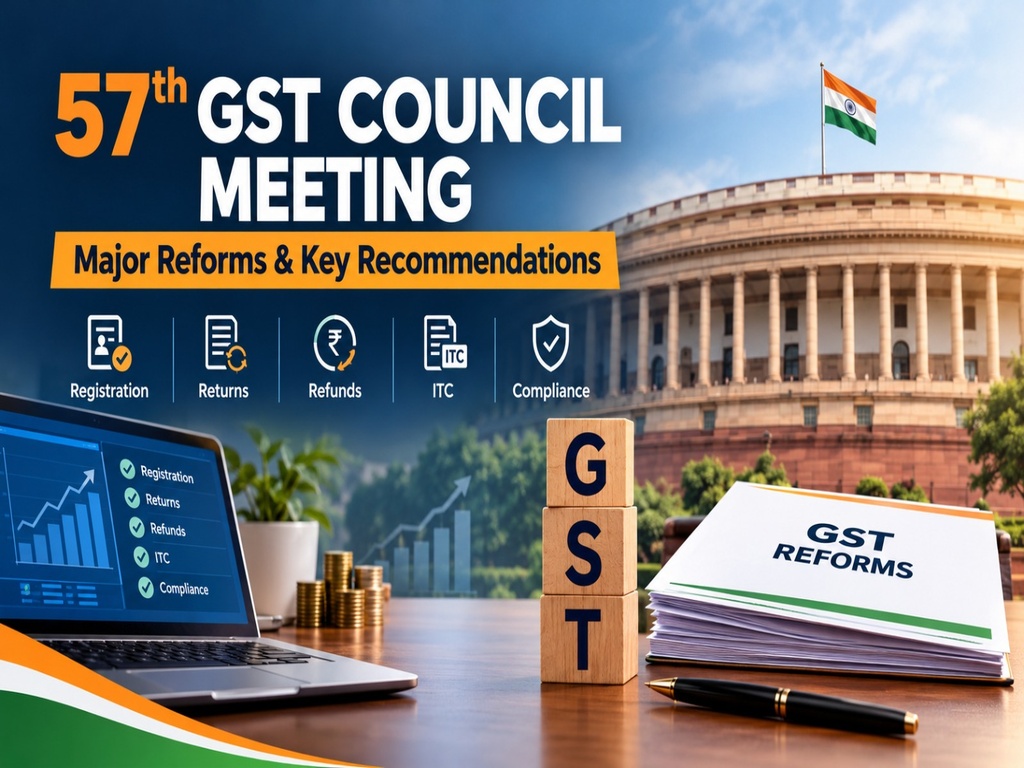
The 57th GST Council meeting marks one of the most significant overhauls of the GST procedural and legal architecture since inception. The reforms span four broad pillars — registration simplification, return-filing automation, refund processing automation, and dispute resolution rationalization — collectively termed “Process Reforms.” In parallel, the Council has recommended structural amendments to ITC provisions (Section 17(5) and Section 54(3)), export/zero-rating facilitation, and landmark decriminalization measures including complete withdrawal of arrest powers under Section 69. Rate rationalizations and sectoral clarifications (second-hand vehicle margin scheme, RCM on specified scrap, EV transport services, ECO delivery services) further round off the reform package. Most process-automation reforms are prospective (many tied to April 2027), while compliance-relief measures (late fee waiver, ITC liberalization) have earlier effective dates. These changes will take legal effect only upon notification of the corresponding CGST Act amendments, CGST Rules amendments, and circulars.
DETAILED EXPLANATION
- PROCESS REFORMS
A1. REGISTRATION-RELATED REFORMS
|
Area |
Key Change |
| Documentation clarity | Comprehensive circular with FAQs on documents/information for registration; FORM GST REG-01 to have drop-down boxes for required documents; improved portal UI with tool-tips/navigation guidance |
| Amendment of registration (Rule 19) | All particulars auto-accepted except Principal Place of Business (PPoB); for Rule 14A auto-registrants, even PPoB amendments auto-accepted |
| Cancellation (on application) | Phase 1: Auto-acceptance of FORM GST REG-16 where returns filed/dues paid and (a) ITC passed on never exceeded ₹2.5 lakh/month, or (b) exceeded but GSTR-10 filed in time. Phase 2: All applications auto-accepted; GSTR-10 details embedded within REG-16 |
| Suo-moto cancellation | Certain grounds under Rule 21 omitted; Rules 21A/22 amended and new Rule 23A inserted for system-based cancellation/revocation for return non-filing or bank-account non-furnishing |
| Small e-commerce sellers | New Rule 14B — automatic registration for small suppliers via ECOs in States without physical presence, by declaring ECO warehouse as PPoB (ITC pass-on ≤ ₹2.5 lakh/month, excluding stock transfers) |
Critical takeaway: This significantly reduces officer interface in registration/cancellation, continuing the automatic registration regime introduced under Rule 14A in the 56th meeting.
A2. RETURN-RELATED REFORMS (EFFECTIVE FROM RETURN FOR APRIL 2027; SUBJECT TO PUBLIC CONSULTATION)
- Enhancements in GSTR-1/1A/IFF for reconciliation with GSTR-3B.
- New Rule 86D — “Electronic Statement of tax paid on RCM basis and ITC claimed.”
- New Rule 86C — “Electronic Credit Reversal and Reclaim Statement.”
- Rule 61(1A) — mechanism to align GSTR-3B liability with GSTR-1/1A/IFF (correction/rectification).
- Rule 61(1B) — mechanism to align GSTR-3B ITC with GSTR-2B.
- Rule 60(6A) — IMS enhancement allowing recipients to accept/reject/keep pending inward supply documents for GSTR-2B generation (including timelines for credit notes kept pending).
- FORM GST DRC-03 amended to capture underlying invoice details against which payment is made.
Critical takeaway: This is designed to structurally eliminate GSTR-1 vs 3B and 3B vs 2B mismatches — the single largest source of automated demand notices (DRC-01B/01C) today.
A3. REFUND-RELATED REFORMS
Phase 1
- Full automatic sanction of excess cash ledger refund;
- acknowledgement/deficiency memo timeline reduced 15 → 10 days with deemed acknowledgement on non-issuance;
- 90% provisional auto-sanction for zero-rated supply/inverted duty structure refunds (system-based risk evaluation)
Phase 2
- Automated acknowledgement + automated full sanction for zero-rated supply refunds after adjusting pending dues
Additional changes:
- FORM GST RFD-01 — system-readable format; no scanned document upload for zero-rated/inverted duty refunds.
- Rule 89(4)(C) — removal of the 1.5x cap on zero-rated goods turnover vis-à-vis like domestic supplies.
- Section 54(14) — ₹1,000 minimum refund threshold now applies to the aggregate of CGST + SGST/UTGST + IGST.
- Section 115 — made standalone for interest rate on refund of pre-deposit; circular to follow for clarity.
A4. DISPUTE RESOLUTION REFORMS
- Circular mandating quality/timeliness standards for notices, adjudication and appellate orders; proper invocation of fraud/suppression grounds only on merit; adherence to natural justice (personal hearing) to be issued seperately.
- Sections 73/74/74A amendments:
- No SCN where tax amount < ₹10,000 (CGST+SGST+IGST+Cess combined) — applies retrospectively to pending notices/appeals as if threshold always existed.
- Penalty deemed as “charge” where full tax, interest, and penalty voluntarily paid within specified time.
- Reduced 5% penalty in non-fraud cases if tax + interest paid within 30 days (S.73) / 60 days (S.74A) of adjudication order.
- Minimum penalty of ₹10,000 in non-fraud cases removed.
- Section 125 — maximum general penalty reduced from ₹25,000 to ₹10,000.
- Sections 107(6)/112(8) — pre-deposit for penalty-only orders (no tax demand) capped at ₹40 crore (₹20 crore CGST + ₹20 crore SGST/UTGST).
Critical takeaway: This is a major litigation-reduction and taxpayer-friendly measure, effectively decriminalizing small-value disputes and reducing frivolous SCNs.
- OTHER MAJOR STRUCTURAL REFORMS
B1. INPUT TAX CREDIT RATIONALIZATION
| Provision | Change |
| Section 54(3) — Zero-rated supplies | Refund of accumulated ITC extended to capital goods |
| Section 54(3) — Inverted duty structure | Refund extended to input services (ITC availed on/after 1 Nov 2026) and capital goods (spread over 60 months, ITC availed on/after 1 Apr 2027) |
| Section 17(5) | Blocked credit restrictions removed for: outdoor catering, health & life insurance, telecom towers, pipelines laid outside factory premises, free samples, and goods destroyed/written off on expiry of shelf life as mandated by law |
Critical takeaway: This directly addresses long-standing working-capital blockage and cascading-tax concerns, particularly for export-oriented and inverted-duty sectors (pharma, textiles, renewable energy).
B2. EXPORT / ZERO-RATING REFORMS
- Section 2(6)(v) IGST Act omitted — removes the “distinct person” bar, allowing supplies to a taxpayer’s own foreign establishment/branch to qualify as “export of services.” Major relief for IT/ITES and professional service exporters routing services through foreign branches.
- Section 13(3)(a) IGST Act omitted — place of supply for services where goods are made physically available by recipient now follows the default rule (recipient’s location) under Section 13(2), facilitating export classification for job-work/repair type services.
- Section 16(1) IGST Act — new explanation: Goods delivered to an overseas buyer at an SEZ/FTWZ, with payment received in convertible foreign exchange/permitted INR, deemed as supply to SEZ/FTWZ — providing certainty on zero-rating for such “bill-to-ship-to” arrangements.
- Circular to be issued clarifying permissible modes of receipt of export proceeds (foreign exchange/INR).
B3. EASE OF LIVING AND DOING BUSINESS
Decriminalization (most critical reform):
- Section 69 omitted — complete withdrawal of arrest powers under GST without court order.
- Prosecution monetary threshold raised from ₹1 crore to ₹5 crore.
- Section 132(1)(i) omitted; “evades tax” deleted from clause (e); “or in any other manner deals with” deleted from clause (h); clause (c) narrowed to cover only fraudulent ITC availment without receipt of goods/services or without invoice.
- Punishment quantum rationalized across offences.
E-way bill rationalization (Sections 68, 129, 130):
- Interception permitted only on specific intelligence with authorization of an officer not below Joint Commissioner rank.
- Action restricted to States where supplier or recipient is located/registered — no interception in transit States.
- Exception: goods without e-way bill or origin/destination documentation can be inspected/detained irrespective of jurisdiction.
- Section 130 confiscation not applicable to goods/conveyances in transit.
Other key changes:
- Schedule II amendment — transfer of title in IPR (temporary or permanent) uniformly treated as supply of services.
- Rule 86A amendment — taxpayer entitled to file objection against ECL blocking and avail personal hearing before decision.
- Late fee waiver under Section 39(1) for turnover ≤ ₹5 crore (preceding FY), if delayed return filed by end of month in which due.
- Clarificatory circulars expected on: ISD mechanism, ITC for banks/NBFCs opting Section 17(4), pre-deposit payment issues, ITC on demonstration vehicles, and retrospective omission of Rule 96(10) effective 23.10.2017 (in line with Supreme Court ruling).
- In-principle approval of optional Annual Return Quarterly Payment (ARQP) scheme for exclusively B2C taxpayers with turnover ≤ ₹5 crore.
- Sections 16, 37, 39 to be aligned with the Section 16(4) ITC time limit; Section 9(5) clarified on ECO liability irrespective of business model; validation clause for notices invalidated by courts on multi-year grounds; e-invoicing extended to RCM purchases from unregistered persons and import of services (turnover ≥ ₹5 crore).
- GSTAT provisions aligned with the Tribunals Reforms Act, 2026.
- RATE AND CLASSIFICATION CHANGES
| Item/Sector | Clarification/Change |
| Second-hand vehicle margin scheme | ITC permitted on inputs/input services other than the second-hand vehicle itself (spares, repairs, marketing, rent, etc.) |
| Plastic/e-waste/tyre waste/used cooking oil | RCM on supply from unregistered to registered persons; 2% TDS on B2B supply |
| Psyllium (Isabgol) seeds | NIL rate irrespective of form (fresh/chilled/frozen/dried) |
| Toys (HSN 9503) | Clarified to cover all toy categories, not restricted to tricycles/scooters/pedal cars |
| EV passenger transport/rental services | Option of 5% GST with restricted ITC where battery charging cost is included |
| ECO delivery services | Non-courier delivery services via ECO brought under Section 9(5); 5% without ITC prescribed; GTA exemption (Entry 21A) excluded for ECO-sourced goods |
| Same-line-of-business ITC | Extended to restaurant/outdoor catering, hotel accommodation (≤ ₹7,500/unit/day), and gym/fitness services |
| Highway TOT model | Toll collection rights granted to concessionaires exempted; special valuation/timing procedure for O&M services |
Concluding Note: These recommendations, once notified through amendments to the CGST Act, CGST Rules and accompanying circulars, represent a decisive shift toward a technology-driven, non-adversarial, litigation-light GST ecosystem. Practitioners should closely track the notification dates for each reform, as several — particularly return and ITC-related changes — have deferred prospective applicability.