Team SKM,
Taxation of income, especially for businesses, traditionally depends on meticulous maintenance of accounts, vouchers, and audits. However, for small businesses, MSMEs, start-ups, and professionals, this compliance burden often feels overwhelming and time-consuming.
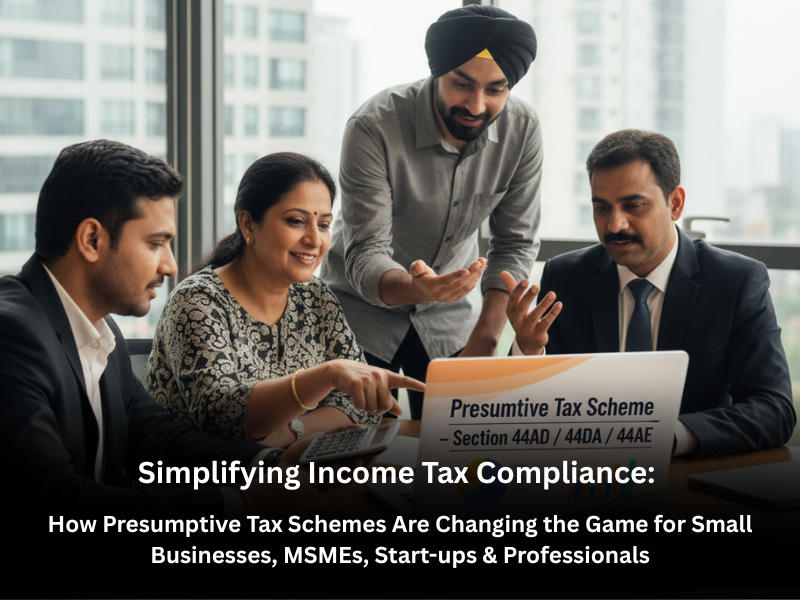
To simplify this, the Income Tax Act introduced the concept of Presumptive Taxation, which allows eligible taxpayers to declare income at a fixed percentage of their turnover or receipts, without maintaining detailed books or going through audits.
The core idea is simple — instead of computing exact profits through complex calculations, a “presumption” is made that the taxpayer’s income is not less than a specified percentage of their turnover.
The Mechanics of Presumption
Under presumptive taxation, income is not calculated based on actual profits or expenses. Instead, it’s mechanically defined -a fixed percentage of your total sales or receipts is considered as your taxable income.
This approach offers relief from the tedious task of maintaining detailed records and audits, especially for small taxpayers.
The Income Tax Act provides three major presumptive schemes targeting different taxpayer groups:
1. Small Businesses – Section 44AD
Eligibility:
- Applicable to Resident Individuals, Hindu Undivided Families (HUFs), and Partnership Firms (excluding LLPs)
- Turnover or gross receipts should not exceed ₹2 crore
Presumed Income:
- 8% of turnover for cash receipts
- 6% of turnover for digital receipts (through account payee cheque, bank draft, UPI, or ECS)
These percentages are minimum benchmarks. Taxpayers can voluntarily declare a higher profit percentage if they wish.
Example:
If a small business has a turnover of ₹1.5 crore –
- Digital receipts: 6% × ₹1.5 crore = ₹9 lakh (presumed income)
- Tax is computed on ₹9 lakh only, without maintaining books or audit.
However, if the taxpayer wants to declare profit below 6% or 8%, then:
- Proper books of accounts must be maintained, and
- Tax audit becomes mandatory under Section 44AB.
Further, once a taxpayer opts out of Section 44AD (by declaring lower income), they cannot re-enter this scheme for the next 5 years.
2. Eligible Professionals – Section 44ADA
Applicable to: Professionals such as doctors, lawyers, architects, engineers, accountants, consultants, etc.
Eligibility:
- Total gross receipts should not exceed ₹50 lakh in a financial year.
Presumed Income:
- 50% of the total gross receipts are treated as taxable income.
If a professional declares less than 50% profit, they must maintain books of accounts and get them audited.
3. Goods Transport Operators – Section 44AE
Applicable to:
Persons engaged in the business of plying, hiring, or leasing goods carriages, owning not more than 10 vehicles at any time during the year.
Presumed Income:
A fixed monthly income is calculated for each vehicle based on its weight or type, irrespective of actual profits or expenses.
The Compliance Dividend
The biggest advantage of presumptive schemes is the massive reduction in compliance burden.
Taxpayers opting for presumptive taxation:
- Don’t need to maintain detailed books of accounts (as per Section 44AA)
- Don’t require a tax audit (as per Section 44AB)
- Can file their return using the simplified ITR-4 (Sugam) Form
Additionally, they also enjoy simplified advance tax rules – they only need to pay the entire advance tax by 15th March of the financial year, instead of quarterly installments in June, September, December, and March.
🔹 The Trade-Off: Simplicity vs. Flexibility
While presumptive taxation reduces compliance hassles, it comes with certain trade-offs:
- No separate deduction for business expenses or depreciation is allowed.
- The declared profit (6%, 8%, 50%, etc.) is treated as final taxable income.
- Only partnership firms under Section 44AE can claim deductions for partner’s remuneration and interest.
This means even if your actual expenses are higher or your real profit is lower, you’ll still be taxed on the presumed percentage – ensuring administrative simplicity but reducing flexibility.
Final Thoughts
Presumptive taxation provides a smart, simplified, and compliance-light route for India’s small businesses, MSMEs, start-ups, and professionals to meet their tax obligations.
Those who prefer to show a lower profit percentage (below 6% or 8%) can still do so – but they’ll need to maintain books and get their accounts audited.
In essence, presumptive schemes strike a practical balance:
Ease of compliance in exchange for a fixed, minimum taxation base.
For small taxpayers, it’s truly a game-changer – reducing stress, saving time, and ensuring smoother compliance with India’s tax system.