
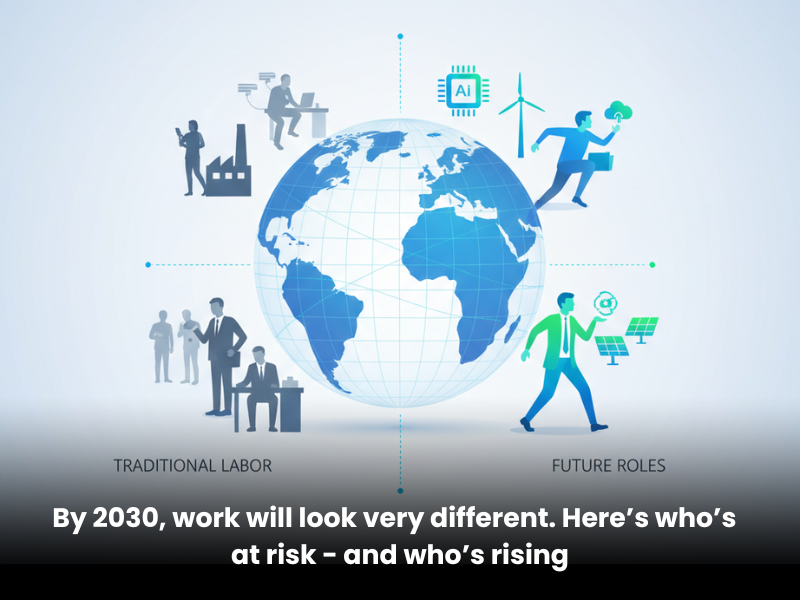
A major reshaping of the global job market is already underway, and it’s accelerating. According to the World Economic Forum’s Future of Jobs Report 2025, the next five years will bring the sharpest churn in employment the world has seen in decades.
Technology, artificial intelligence, ageing populations, geopolitics, and cost pressures are colliding. The result is not just job losses or job creation – but a reordering of what skills are valued and what roles survive.
The difference between staying relevant and falling behind will come down to how adaptable your work is.
The roles most exposed to decline
Jobs built around routine, repeatable tasks are under the most pressure. These roles are easier to automate, outsource, or digitise, especially as companies push for efficiency and lower costs.
The WEF flags a steady drop in demand for roles such as:
- Data entry and clerical positions
- Cashiers, ticket clerks and bank tellers
- Accountants, auditors, payroll and bookkeeping staff
- Administrative and executive secretaries
- Claims adjusters and routine compliance roles
- Assembly-line manufacturing and basic factory jobs
- Print-related trades and some graphic design work
- Security and monitoring roles with limited judgement
- Middle layers of business administration and services management
This does not mean these jobs vanish overnight. But it does mean fewer openings, slower wage growth, and higher competition – especially where AI systems can now perform the same tasks faster and at lower cost.
AI isn’t just replacing jobs – it’s redirecting them
While certain roles shrink, new ones are expanding quickly. Nearly half of global employers surveyed by the WEF say they plan to restructure their business models around AI-driven opportunities.
That shift is creating strong demand for people who build, manage, secure and interpret technology – not just operate it.
Roles expected to grow fastest include:
- AI and machine learning specialists
- Data analysts and data scientists
- Cybersecurity and network protection experts
- Cloud platform and infrastructure engineers
- Robotics and automation specialists
These jobs sit at the intersection of technical capability and problem-solving, where human judgement still matters.
Human skills are becoming the real differentiator
One of the clearest messages in the report is that technology alone is not enough. As machines take over routine execution, employers are placing more value on skills that cannot be easily automated.
Demand is rising for people who can:
- Think analytically and solve unfamiliar problems
- Communicate clearly across teams and cultures
- Lead, collaborate and manage uncertainty
- Show creativity, resilience and ethical judgement
In many roles, these human capabilities matter as much as technical knowledge.
Growth areas beyond pure tech
Not all future-proof jobs are in software or engineering. Structural shifts in society are driving demand elsewhere too.
The WEF highlights growth in:
- Healthcare and care economy roles, as populations age
- Education, training and upskilling professionals
- Sustainability, climate transition and green energy roles
- Risk analysis, compliance, geopolitics and policy-related work
These roles benefit from demographic change, regulation, and global instability – forces that technology alone cannot replace.
The future job will be hybrid
Perhaps the most important takeaway: future roles won’t be neatly divided into “tech” and “non-tech”.
Most jobs will require a blend of:
- Digital literacy
- Domain or business understanding
- Communication and judgement
- The ability to learn continuously
People who can reskill, adapt tools to their work, and move across functions will remain employable even as job titles change.
The bottom line
By 2030, the WEF estimates that 59% of the global workforce will need reskilling. Millions of workers face redundancy not because they lack effort, but because their roles no longer fit how value is created.
The choice is stark:
- Routine work will continue to shrink
- Skill-rich, adaptable work will expand
Careers of the future will belong to those who keep learning, use technology as leverage, and double down on what machines still can’t do.