
Team SKM,
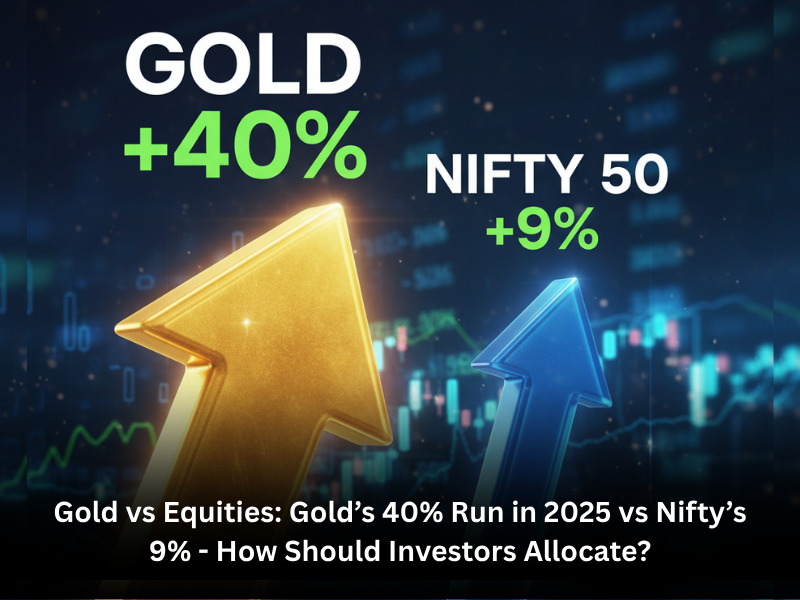
Gold has been the standout performer of 2025, rising more than 40 per cent, while the Nifty 50 has delivered a comparatively modest 9 per cent gain. This sharp divergence has prompted investors to re-evaluate their asset mix, especially as global uncertainty keeps demand for safe-haven assets elevated.
The strength in gold prices this year has been supported by three key factors:
- Persistent geopolitical risks in Eastern Europe and the Middle East
- A weaker US Dollar, which has declined nearly 8 per cent against major currencies
- Continued buying by global central banks, adding structural support to prices
With these drivers in place, investors are now weighing whether to increase gold exposure or continue prioritizing equities for long-term returns.
Gold performs well – but it does not replace equities
Market experts broadly agree that gold is a useful risk-management asset, but not a substitute for equities.
Gold’s rally in 2025 reflects global uncertainty, expectations of lower interest rates and strong central bank demand. In the near term, this offers stability and diversification benefits.
However, long-term data continues to favor equities for wealth creation. Equity markets, particularly in an economy like India, benefit from earnings growth, domestic consumption, rising corporate profits and long-term economic expansion. Gold, by contrast, offers protection during volatile periods but does not compound wealth the way equities do.
Several investment managers highlight the same principle:
- Gold helps reduce portfolio volatility
- Equities remain the primary long-term compounding engine
- Investor behavior should not be driven solely by short-term performance
The surge in gold inflows should not tempt investors to shift heavily into a single theme based on one strong year.
What should investors do now? A disciplined allocation framework
A measured allocation strategy remains the most prudent approach.
1. Retain equities as the core allocation
Equities continue to offer the strongest long-term return potential. India’s corporate earnings outlook, improving margins and structural domestic growth make them a foundational component of any portfolio.
2. Use gold as a complementary asset, not the centerpiece
Gold can mitigate risk, offer inflation protection and provide balance during global uncertainty. For most long-term investors, the appropriate gold range lies between 5 per cent and 20 per cent, depending on risk tolerance and goals.
3. Avoid chasing recent performance
2025’s exceptional gold returns are not a reason to overhaul long-term strategy. Excessive concentration – such as gold allocations beyond 30 per cent – increases volatility and is suitable only for investors with high risk appetite.
4. Consider the current phase of the precious metals cycle
Research heads note that the precious metals cycle that began in 2023 is still in progress, with potential to run until 2029–2030. However, cycles mature, and allocations that suited the 2023–2025 breakout phase will not necessarily be optimal going forward.
A balanced approach – equities for growth and gold for diversification – remains the most appropriate strategy in this phase.
Bottom line
Gold’s 2025 rally highlights its role as a reliable hedge during periods of global risk, but it does not replace equities as the primary long-term growth asset. A diversified approach, with a clear allocation framework and emphasis on long-term strategy rather than short-term performance, continues to offer the best outcomes for investors.