
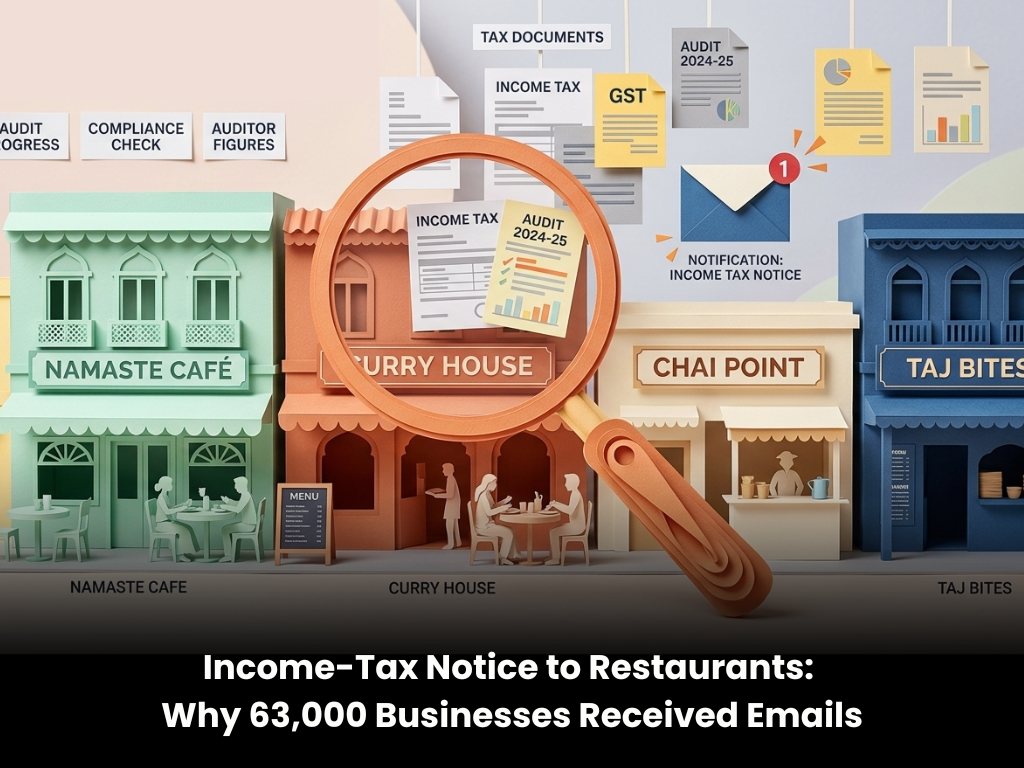
As the financial year approaches its closing weeks, another compliance issue has quietly emerged for the restaurant industry. The Income-Tax Department has reportedly sent communication to around 63,000 restaurants across India, asking them to review and correct their income disclosures before March 31.
The emails are part of what officials describe as a “nudge” initiative. Rather than launching immediate enforcement action, the department is encouraging businesses to voluntarily update their tax filings if discrepancies exist.
For restaurant owners and accountants handling hospitality clients, the development is a reminder that transactional data is now being examined far more closely than before.
How the Discrepancies Were Detected
According to a statement from the finance ministry, the department analysed transactional data from nearly 1.77 lakh restaurants operating in the Food & Beverage sector.
The analysis was carried out using AI-enabled data tools.
These systems compared digital transaction records with the turnover figures reported in Income-Tax Returns. In many cases, the numbers did not match.
Officials said the data review suggested that some establishments had reported lower revenues than what their transaction patterns indicated.
The department believes certain practices may have contributed to this mismatch.
These include deletion of bulk bills from billing systems or modifications made to recorded transactions, potentially reducing the visible sales figures.
Nationwide Survey and Initial Findings
Following the data analysis exercise, the department carried out a limited field verification in early March.
A survey was conducted at 62 restaurant locations across 46 cities in 22 states. The preliminary findings suggested suppression of sales amounting to roughly ₹408 crore.
Authorities have indicated that further verification is ongoing.
At the moment, however, the department’s immediate focus appears to be encouraging voluntary compliance rather than initiating widespread enforcement proceedings.
What the Email Communication Means
The emails sent to restaurants are essentially a request to review previously filed tax returns.
If a taxpayer identifies mistakes or omissions, the department has advised them to correct the filings using the updated return mechanism available under Section 139(8A) of the Income-Tax Act.
This provision allows taxpayers to revise earlier returns within a specified time frame by paying applicable additional tax and interest.
For many businesses, especially those with complex billing systems or high transaction volumes, such corrections may help avoid deeper scrutiny later.
Why the Restaurant Sector Is Under Focus
The Food & Beverage sector has long been considered challenging from a tax compliance perspective.
Restaurants typically deal with a large number of small transactions each day, often across multiple payment channels including cash, cards and digital platforms.
This makes the sector particularly suitable for data-driven scrutiny.
With the increasing availability of digital payment data and billing system information, tax authorities now have greater visibility into real transaction patterns.
As a result, differences between recorded sales and reported income can be detected more easily than before.
What Restaurant Businesses Should Do Now
For restaurant owners who have received such communication, the first step is usually to review accounting records carefully.
This includes reconciling:
• billing software records
• bank and payment gateway statements
• GST filings
• income tax returns
If inconsistencies are found, filing an updated return may be the most straightforward way to resolve the issue.
Tax professionals handling clients in the hospitality sector may also want to review internal billing practices and reporting systems to ensure that all transactions are properly captured.
A Broader Shift Toward Data-Driven Compliance
The latest exercise highlights a broader change in the tax administration approach.
Instead of relying solely on traditional surveys and audits, authorities are increasingly using data analytics to identify potential mismatches.
For businesses, this means compliance is no longer limited to filing returns on time. The underlying data behind those returns is now being analysed more closely.
In that environment, maintaining consistent records across billing systems, GST filings and income tax returns becomes critical.
Sometimes, small discrepancies may simply arise from operational gaps. But once detected through automated analysis, they can still attract attention.
A Quiet Reminder for Businesses
For the restaurant industry, the emails sent this month serve as a gentle but clear reminder.
Digital records leave traces. And those traces are now being examined with far greater precision.
For businesses that maintain clean books and transparent reporting, this shift should not create concern.
But for those with inconsistencies between actual sales and declared income, the coming weeks may be an opportunity to correct the record before the financial year closes.