
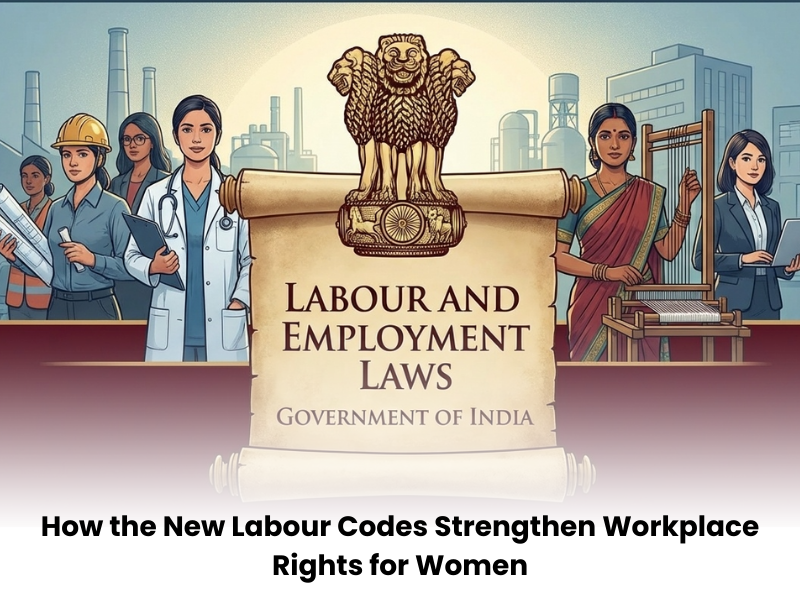
The Government of India has notified that all four labour codes – the Code on Wages (2019), Industrial Relations Code (2020), Code on Social Security (2020), and the Occupational Safety, Health and Working Conditions (OSHWC) Code (2020) – will come into force from 21 November 2025. Together, these consolidate 29 existing laws and create a unified labour framework for employers.
A significant part of this transition concerns stronger workplace protections for women, with several changes aimed at improving equality, participation and safety.
1. Equal pay becomes a statutory mandate
The Code on Wages makes equal pay for equal work a legal requirement across all sectors. This removes ambiguity that earlier allowed wage differentials to persist. Employers must ensure that women are compensated at par with men for similar roles and responsibilities, and discrepancies can now attract compliance action.
2. Mandatory representation in grievance committees
The new framework requires women to be included in workplace grievance redressal committees. This strengthens the handling of matters related to discrimination, harassment, and working conditions by ensuring women’s voices are formally part of the process.
3. Expanded definition of “family” for female employees
Under the Code on Social Security, the definition of “family” for women employees can now include parents-in-law if the employee chooses to nominate them. This expands the coverage of social-security benefits to dependents who often form part of a woman’s caregiving responsibilities.
4. Social security access for gig and platform workers
The codes extend social-security benefits to gig workers, platform workers and workers in the unorganised sector — categories where a significant proportion of women are employed but traditionally lacked formal protections.
5. Safer participation in night-shift work
The OSHWC Code permits women to work night shifts with their consent, subject to mandatory safety measures. This provision opens opportunities in sectors such as IT, logistics, manufacturing and services while placing clear responsibility on employers to provide safe working environments.
6. Formalisation benefits women disproportionately
Provisions such as mandatory appointment letters, uniform wage definitions, digital records and centralised compliance systems support the formalisation of employment relationships. This is particularly important as women are over-represented in informal jobs with limited security.
7. Transition and compliance considerations for employers
Although the codes are now notified, the transition will progress as corresponding rules and schemes are rolled out. Until then, some provisions from earlier labour laws may continue to apply in parallel. Employers should therefore:
- Review HR policies and employment contracts
- Update salary structures to align with the uniform definition of “wages”
- Reconstitute grievance and internal committees to ensure compliance
- Assess workplace safety protocols, especially for night-shift roles
- Prepare for digital compliance and record-keeping requirements
These reforms mark a substantial move towards a more inclusive and equitable labour framework. While the initial transition may require operational realignment, the long-term impact is expected to support greater workforce participation, transparency and gender parity across industries.