
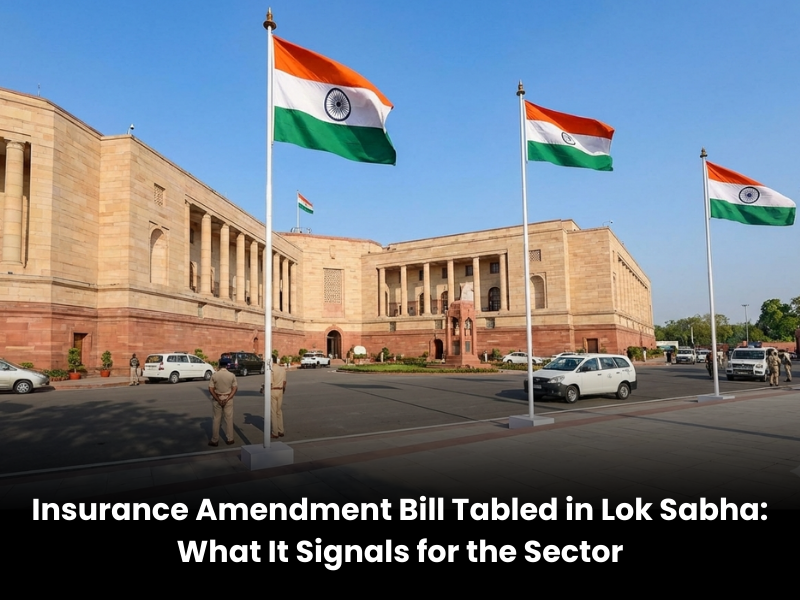
Finance Minister Nirmala Sitharaman on December 16 introduced the Insurance Laws Amendment Bill in the Lok Sabha, formally placing the proposed changes to India’s insurance framework before Parliament.
At this stage, the Bill has only been tabled. Detailed discussion and clause-by-clause consideration are expected later, with a debate scheduled during the ongoing session. The precise contours of the amendments will become clear once the House takes up the Bill for deliberation.
What the Bill is expected to address
While the text of the Bill is yet to be examined in detail, industry observers expect the amendments to focus on:
- Modernising insurance regulations
- Easing compliance requirements
- Improving capital availability for insurers
- Supporting long-term expansion of insurance coverage
The reforms are aligned with the government’s broader objective of deepening insurance penetration in India, particularly across underinsured and rural segments.
FDI in insurance: A key area to watch
One of the most closely tracked aspects of the proposed amendments is the foreign direct investment (FDI) framework for insurance companies.
India currently permits up to 74% FDI in the sector. Market participants expect the Bill to potentially enable higher foreign participation, subject to safeguards. Additional capital inflows could help insurers strengthen balance sheets and fund growth in capital-intensive segments such as health and general insurance.
Peuli Das, Partner – Actuarial Services at BDO India, noted that the sector has largely utilised the existing FDI limits and that further capital would support penetration and sustainable growth, alongside improved cost discipline and pricing efficiency.
Legal experts also point out that enabling legislative changes could accelerate reforms already under discussion. Aravind Venugopal, Partner at Khaitan & Co, said that a move towards 100% foreign ownership, if permitted, would represent a structural shift, improving governance, accountability and speed of decision-making.
Potential impact on the insurance ecosystem
Higher foreign participation could have spillover effects across the insurance value chain. Industry participants expect:
- Faster scaling by insurers
- Greater focus on product innovation and affordability
- Increased competition, particularly in health and general insurance
- Expansion of allied services such as premium financing and digital distribution
At the same time, experts emphasise that the final framework will need to balance capital inflows with policyholder protection and regulatory oversight.
What clients should note
For insurers, intermediaries and investors, the tabling of the Bill signals policy intent, not immediate change. Until the Bill is debated, amended and passed, existing regulations remain in force.
Clients should monitor:
- Final language on FDI limits and control
- Transitional provisions and compliance timelines
- Any changes affecting capital structure, governance or reporting
The Bill marks a potentially significant step in the evolution of India’s insurance sector, but its practical impact will depend on the details that emerge during Parliamentary scrutiny.