
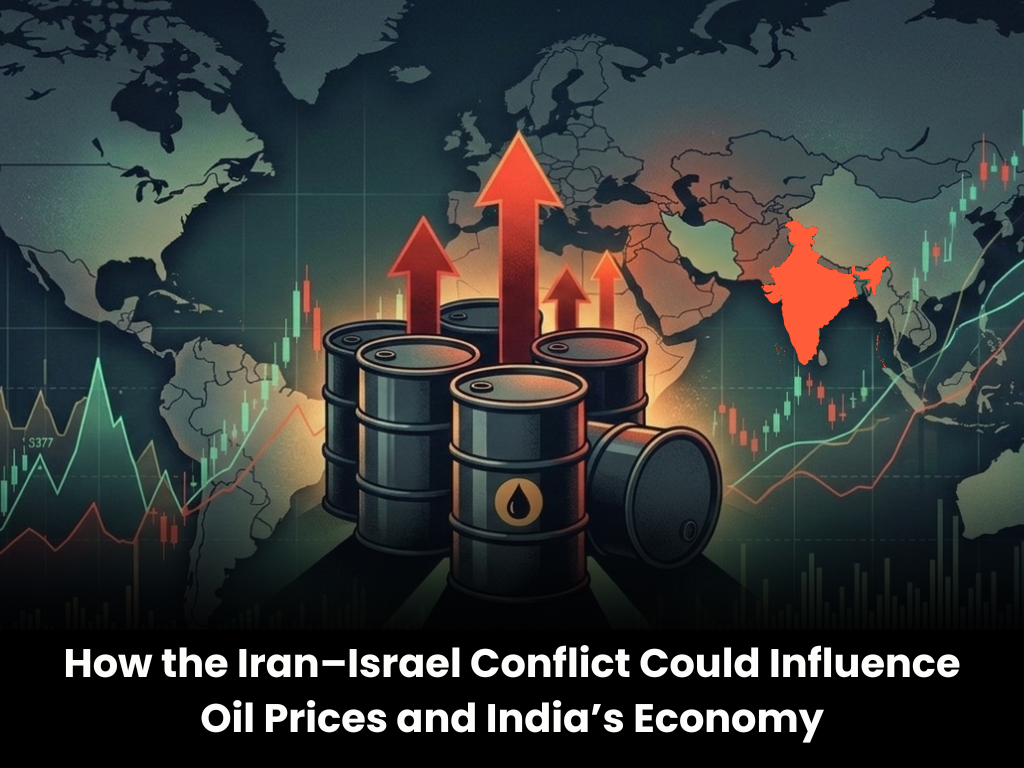
Tensions in the Middle East rarely stay limited to the region itself. When conflict escalates, global markets, especially energy markets, tend to react almost immediately. The current standoff involving Iran and Israel has once again drawn attention to crude oil and the stability of global supply.
Countries that depend heavily on imported energy watch these developments very closely. Oil prices are particularly sensitive to geopolitical risks, and sometimes even the possibility of disruption in the region is enough to trigger volatility in global markets.
For India, the stakes are higher than for many other economies. Since the country imports a large share of the crude oil it consumes, sudden changes in global oil prices can quickly influence inflation, business costs and the broader economic outlook.
Why Conflicts in the Middle East Often Push Oil Prices Higher
The Middle East continues to play a central role in the global oil market. A significant share of the world’s crude oil is produced in Gulf countries, and many of the main shipping routes used to transport that oil pass through the region.
One route that frequently comes up in discussions is the Strait of Hormuz. It is a narrow passage connecting the Persian Gulf to international sea lanes, and a large volume of the world’s oil shipments moves through it every day. Because so much energy trade depends on this corridor, even the possibility of disruption can make markets nervous.
When tensions rise in the region, traders and governments begin to factor in several risks:
• The possibility that the oil supply could be disrupted
• Higher insurance and shipping costs for tankers
• Countries building up emergency oil reserves
• Increased trading activity in oil futures markets
Interestingly, oil prices do not always wait for an actual supply disruption. Sometimes the fear of disruption alone is enough to push prices upward.
Iran’s Strategic Role in Energy Markets
Iran occupies a geographically important position along the northern edge of the Strait of Hormuz. Because of this location, it has the ability to influence maritime traffic through the region.
In periods of heightened tension, the risks are not limited to direct supply cuts. Other developments can also affect global energy flows, including:
• Naval activity near key shipping lanes
• Threats to oil tankers
• Security concerns affecting shipping routes
• Temporary disruptions to regional energy infrastructure
Iran is also a major oil producer and a member of the Organisation of Petroleum Exporting Countries (OPEC). Any restrictions on its production due to sanctions or conflict can tighten global supply.
As a result, energy markets tend to react strongly whenever tensions involving Iran escalate.
Why Oil Price Movements Matter Globally
Higher crude oil prices eventually affect economies far beyond the Middle East.
Oil remains a key input for transportation, manufacturing, logistics and power generation. When crude prices rise, the impact spreads across multiple sectors.
For consumers, this may translate into higher prices for:
• Petrol and diesel
• Airline tickets
• Freight and transportation services
• Electricity in some markets
For businesses, higher fuel and energy costs increase operational expenses and can affect profitability.
The Impact on Oil-Importing Economies
Countries that depend heavily on imported oil are particularly vulnerable to price shocks.
Large importers such as India, Japan, South Korea and many European economies must pay more for energy when crude prices rise. This increases the cost of imports and can widen trade deficits.
Higher oil prices also affect government finances. Many governments either subsidise fuel or face political pressure when fuel prices rise sharply.
As a result, oil market volatility often becomes a broader economic issue.
What Rising Oil Prices Mean for India
India imports around 89% of the crude oil it consumes, and a significant share of those imports comes from the Middle East.
Because of this dependence, oil price movements can influence several macroeconomic indicators in the country.
Higher crude prices may affect:
• Inflation levels
• The fiscal deficit
• Currency stability
• Industrial production costs
For policymakers, monitoring global energy markets becomes an important part of economic management.
Sectors in India That Feel the Impact First
Some sectors in India tend to feel the effect of rising oil prices almost immediately.
Because fuel is such a critical input across the economy, even a moderate increase in crude prices can start showing up in business costs fairly quickly.
Oil refining companies like Indian Oil Corporation, Bharat Petroleum and Hindustan Petroleum often face pressure when crude prices move up sharply. Their input costs rise, while fuel prices in the domestic market may not adjust at the same pace, which can affect margins.
The aviation sector is another area where the impact is visible. Aviation turbine fuel makes up a large part of airline operating costs, so any sustained increase in crude oil prices can quickly affect airline finances and ticket pricing.
In the transport and logistics sector, higher diesel prices typically translate into higher freight charges. This can ripple through supply chains and eventually affect the cost of goods.
Manufacturing businesses and MSMEs can also feel the pressure, especially those that depend heavily on transportation or energy-intensive processes.
Even agriculture may be indirectly affected. Fertiliser production, irrigation systems and the movement of agricultural goods all rely on energy, which means higher oil prices can gradually influence farming costs as well.
Inflation Risks and Economic Policy
Oil price increases often translate into broader inflationary pressure across the economy.
Higher transportation and energy costs tend to raise the price of goods and services over time. If inflation rises sharply, central banks may respond with tighter monetary policy.
While such measures are intended to control inflation, they can also slow economic activity in the short term.
For large developing economies like India, maintaining a balance between growth and inflation becomes more challenging during global energy shocks.
India’s Long-Term Energy Strategy
Events like the Iran–Israel conflict highlight the importance of energy diversification.
India has already taken several steps to reduce the risks associated with heavy dependence on a single region.
Key measures include:
Diversifying crude oil suppliers
India has increased imports from countries such as Russia, the United States and Latin America.
Building strategic petroleum reserves
Strategic oil reserves provide temporary protection against supply disruptions.
Expanding renewable energy capacity
Solar, wind and green hydrogen projects aim to gradually reduce reliance on imported fossil fuels.
Strengthening maritime security
Safe shipping routes remain critical for a country dependent on energy imports.
Bottom Line
Conflicts in the Middle East rarely stay limited to the countries directly involved.
Because the region is such an important source of global oil supply, any rise in tensions there tends to ripple through energy markets and, eventually, the wider economy.
For countries like India that import a large share of their oil, higher crude prices can show up in several ways, from rising inflation to higher business costs and pressure on economic growth.
In that sense, the current Iran–Israel tensions are not just a regional security issue.
They also highlight how closely global energy markets, geopolitics and economic stability are tied to each other.