
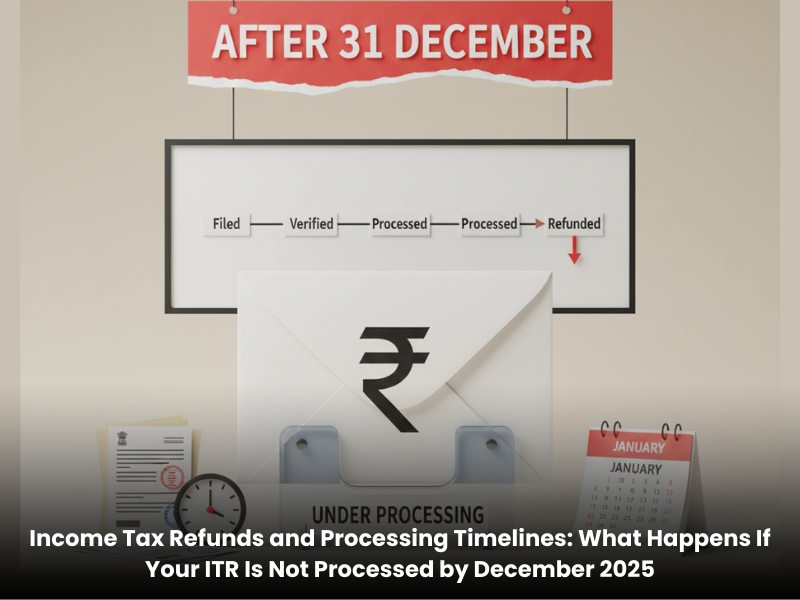
Many taxpayers assume that filing an income tax return completes their obligation. In practice, filing is only the first step. A return attains finality only after it is processed by the Income Tax Department within the timelines prescribed under the Income Tax Act.
As the 31 December 2025 deadline for filing belated and revised returns for Assessment Year 2025–26 approaches, a common concern is whether refunds can be stopped if the return is not processed by that date. The law provides clarity on this issue, and the outcome is often different from what taxpayers fear.
Key Legal Position on ITR Processing
Under Section 143(1) of the Income Tax Act, the Centralised Processing Centre (CPC) is required to process an income tax return and issue an intimation within a prescribed time limit.
For returns filed during Financial Year 2025–26 (relevant to Assessment Year 2025–26):
- The CPC has nine months from the end of the financial year in which the return is filed to process the return.
- Since the financial year ends on 31 March 2026, the CPC has time until 31 December 2026 to process returns filed on:
- The original due date
- The extended due date
- The belated return deadline of 31 December 2025
- The original due date
The actual date of filing within FY 2025–26 does not accelerate or shorten this statutory processing window.
What If the ITR Is Not Processed by 31 December 2026
If the CPC does not process the return within the prescribed time:
- The CPC loses the legal authority to issue an intimation under Section 143(1) after that date.
- The return attains finality as filed, meaning no further adjustments, demands, or corrections can be made through processing.
This applies equally to original, revised, and belated returns filed within FY 2025–26.
Impact on Income Tax Refunds
A common misconception is that refunds are stopped or forfeited if a return is not processed by December 2025. This is incorrect.
If a refund is due as per the return:
- The taxpayer remains entitled to the refund, even if the return is not processed by the CPC within the statutory timeline.
- The refund must be issued along with interest under Section 244A, calculated from the applicable date until the date the refund is granted.
Delayed processing does not extinguish the taxpayer’s right to a legitimate refund.
What Taxpayers Can Do If Processing Is Delayed
If an ITR remains unprocessed for an extended period, taxpayers may take practical follow-up steps, including:
- Raising an online grievance through the e-filing portal
- Using the CPGRAMS or e-Nivaran grievance mechanism
- Submitting a formal follow-up request for processing
These steps are particularly relevant where refunds are involved or where no communication has been received for a prolonged period.
Who Should Be Especially Alert
- Taxpayers expecting refunds, especially after filing revised or belated returns
- Those who corrected mismatches near the December deadline
- Individuals with complex disclosures, where processing timelines may extend
While delay does not negate refund entitlement, timely follow-up can reduce waiting periods.
Practical Takeaways
- Filing by 31 December 2025 preserves the right to revise or file belated returns
- Processing timelines extend up to 31 December 2026 for returns filed in FY 2025–26
- Refunds are not lost merely because processing is delayed
- Interest under Section 244A applies if refunds are issued after the statutory period
- Proactive grievance filing can help expedite processing where delays occur
Closing Note
The income tax framework clearly separates filing deadlines from processing deadlines. While 31 December 2025 is critical for taxpayers’ filing options, it does not determine whether a refund will be issued.
As long as a return is validly filed within the permitted timelines, the law protects the taxpayer’s right to refunds and interest, even if administrative processing takes longer than expected.