
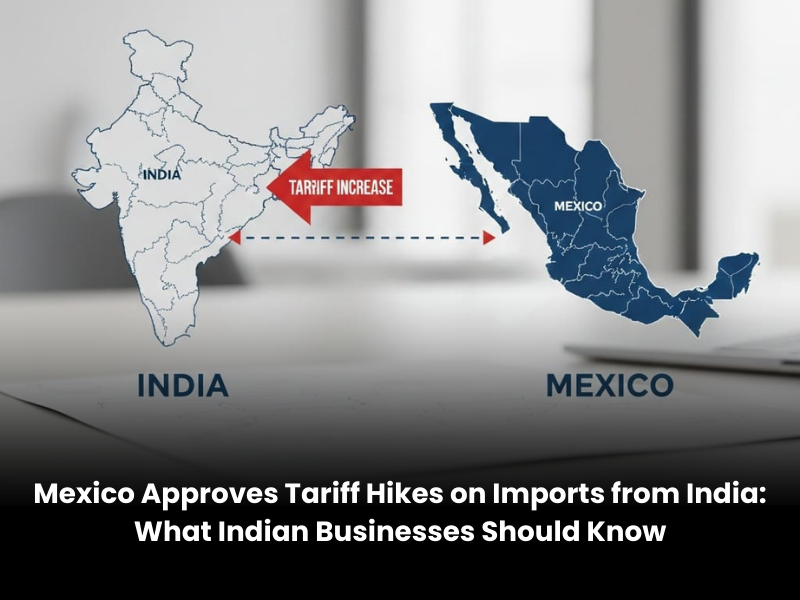
Mexico’s Senate has approved significant tariff increases – up to 50% – on imports from countries without a trade agreement, including India, China, South Korea, Thailand and Indonesia. The new duties will take effect in 2026 and will impact several key export categories.
This measure aims to protect Mexican domestic industries and prepare for the USMCA (United States-Mexico-Canada Agreement) review next year. However, it raises compliance and cost considerations for Indian exporters and multinational supply chains.
What Mexico Has Approved
- Tariffs of up to 50% on selected imports from Asian economies without free-trade agreements.
- Most products will face duties up to 35%.
- Affects sectors including:
- Vehicles and auto parts
- Textiles and apparel
- Plastics
- Steel and metal products
- Footwear
- Vehicles and auto parts
- The final bill includes 1,400 tariff lines, with reduced rates compared to earlier proposals.
Mexico expects the tariff changes to generate USD 3.76 billion in additional revenue in 2026.
Why Mexico Is Raising Tariffs
Analysts point to three key drivers:
- Strengthening domestic manufacturing in labour- and capital-intensive sectors.
- Addressing concerns from the US ahead of the USMCA review.
- Increasing government revenue to lower fiscal deficits.
Although positioned as a competitiveness measure, tariffs will likely increase the landed price of Asian goods in Mexico.
Impact on India’s Export Basket
India exported USD 5.63 billion to Mexico in 2024.
Major categories likely to be affected include:
| Export Category | Value (2024) |
| Vehicles (other than railway) | USD 1.86B |
| Electrical & electronics | USD 612M |
| Machinery & boilers | USD 560M |
| Organic chemicals | USD 388M |
| Aluminium | USD 386M |
| Pharmaceuticals | USD 211M |
| Iron & steel + articles | ~USD 311M combined |
| Plastics | USD 133M |
| Apparel (knit & non-knit) | ~USD 195M combined |
| Ceramics | USD 120M |
These categories fall within the tariff lines Mexico has reclassified.
Potential Implications for Indian Businesses
1. Higher landed cost of Indian goods
Tariffs of 35 – 50% will directly increase import duties in Mexico, impacting B2B and B2C pricing.
2. Possible supply-chain restructuring
Mexican buyers may shift sourcing to:
- USMCA members (US, Canada)
- Countries with FTAs with Mexico
Suppliers may need to evaluate whether assembling partial components in eligible markets reduces net duty.
3. Margin pressure for Indian exporters
Exporters in automotive, textiles, chemicals, plastics and steel may need to revisit:
- Contract pricing
- Delivery terms
- Margin structures
- Logistics costs
4. Transfer-pricing and tax considerations
Multinationals with operations in Mexico may see:
- Changes in customs valuation
- Higher effective tax cost due to tariff-inclusive inventory valuation
- Adjustments in intercompany pricing to maintain arm’s-length benchmarks
5. Risk of retaliatory measures is limited
No immediate tariff response from India is expected as bilateral trade is modest relative to other partners.
What Businesses Should Do Now
For Exporters
- Identify HS codes affected by the new tariff list.
- Engage Mexican distributors to assess price sensitivity.
- Explore tariff-efficient supply-chain models (assembly, local value addition).
- Evaluate impact on export pricing under existing contracts.
For Importers (Indian companies with Mexican subsidiaries)
- Revisit landed cost projections for 2026.
- Revise budgets, cost sheets, and transfer-pricing assumptions.
- Assess whether shifting procurement to USMCA markets reduces duties.
For CFOs & Tax Teams
- Factor higher duties into:
- Inventory costing
- Customs compliance
- TP adjustments
- Profitability analysis
- Inventory costing
Outlook
Mexico’s decision marks a shift in its trade posture at a time when global supply chains are realigning. For India, the impact will primarily be felt in automotive, engineering goods, chemicals, textiles, and plastics, which form the core of its exports to Mexico.
Indian exporters should plan for higher market-entry costs from 2026, evaluate alternative routes, and recalibrate commercial terms with Mexican buyers.