
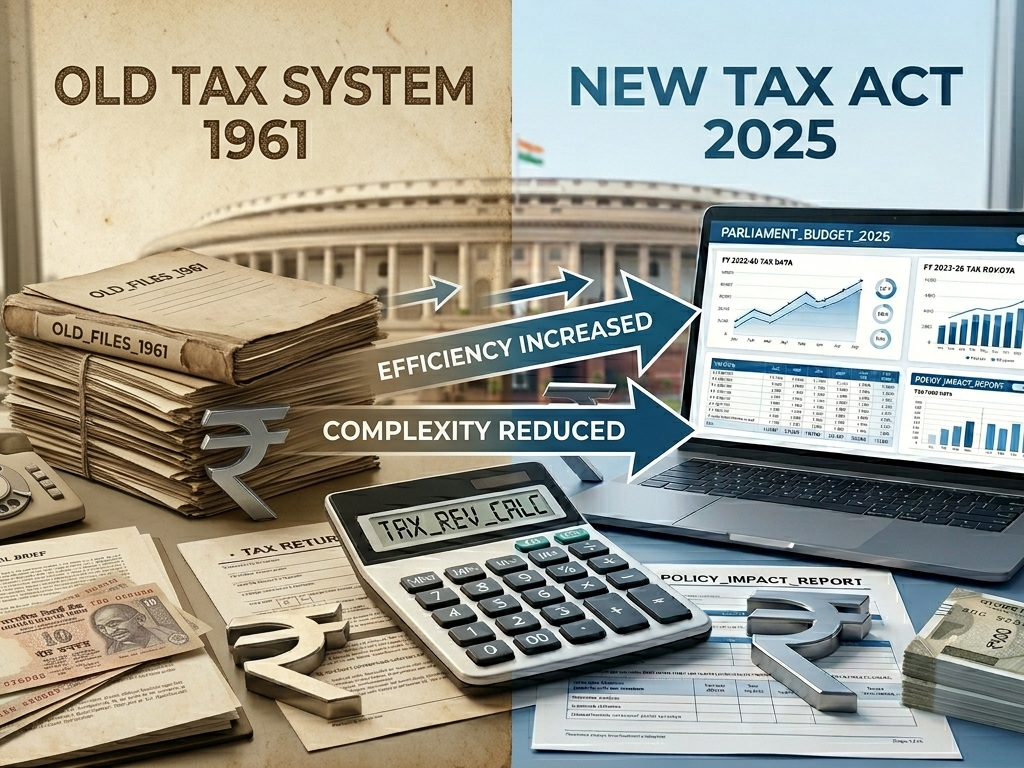
India’s Income Tax Act of 1961 stands replaced by the Income Tax Act of 2025, effective April 1, 2026. The changes span terminology, filing deadlines, perquisites, investment taxation, and foreign remittances. Here is what your business or personal tax position needs to account for.
Terminology
“Financial Year” and “Assessment Year” have been replaced by a single term – “Tax Year.” A structural change, but one that affects all filings and communications going forward.
Filing Deadlines
- Salaried individuals (ITR-1 & ITR-2): July 31 – unchanged
- Non-audit cases (ITR-3 & ITR-4): Extended to August 31
- Revised returns: Deadline extended from December 31 to March 31, though filing after December 31 attracts additional fees
Perquisites and Allowances – Significant Updates
Several long-overdue revisions here:
- Meal cards: Tax-free limit raised to Rs 200 per meal, up from Rs 50
- Gift vouchers: Annual exemption raised to Rs 15,000 per employee, up from Rs 5,000 – applicable under both regimes
- Children’s education allowance: Rs 3,000 per month per child, up from Rs 100
- Hostel allowance: Rs 9,000 per month, up from Rs 300
- Company cars: Perquisite value revised to Rs 8,000/month (up to 1.6L engine) and Rs 10,000/month (above 1.6L); driver perquisite at Rs 3,000/month
These are meaningful changes for salary structuring conversations with your employer clients.
HRA
Tighter compliance requirements. Landlord PAN submission is now mandatory in certain cases, along with valid rent proof. The list of cities eligible for the 50% HRA exemption now includes Bengaluru, Hyderabad, Pune, and Ahmedabad, in addition to the existing metros.
Investment Taxation
Stock buybacks – treatment has shifted from deemed dividend (taxed at slab rates) to capital gains. Effective tax rates now vary: roughly 30% for individual promoters, 22% for corporate promoters, and STCG or LTCG rates for retail investors depending on holding period.
Sovereign Gold Bonds – tax exemption on redemption now applies only to bonds purchased at original issuance. Secondary market purchases will be subject to capital gains tax at redemption.
Dividends and mutual funds – income from these sources will be computed without allowing deduction of interest expenses, even where investment was funded by borrowing.
F&O Traders
STT has increased across the board:
- Options (premium): 0.1% → 0.15%
- Options (intrinsic): 0.125% → 0.15%
- Futures: 0.02% → 0.05%
Higher transaction costs on every trade.
TCS on Foreign Spending
Significantly simplified:
- Foreign tours: Flat 2%, replacing the earlier 5%/20% slab structure
- Education and medical remittances above Rs 10 lakh: Reduced to 2% from 5%
Lower upfront outgo for clients with international travel or overseas education expenses.
PAN Changes
Aadhaar-only PAN applications are no longer permitted. Category-specific forms are now required – Form 93 for individuals, Form 94 for companies, Form 95 for foreign individuals, Form 96 for foreign entities.
PAN is now mandatory for several high-value transactions including cash deposits of Rs 10 lakh or more, vehicle purchases above Rs 5 lakh, hotel or event payments above Rs 1 lakh, and property transactions above Rs 20 lakh.
Other Changes Worth Noting
- Single TDS declaration now valid across multiple income sources – mutual funds, dividends, bonds
- Property purchases from NRIs: Buyers can now use their own PAN for TDS deduction, removing the TAN requirement
- Motor accident compensation interest: Fully tax-exempt, no TDS applicable
Our View
The 2025 Act is largely a restatement and reorganisation of existing law, but several changes have direct planning implications – particularly around perquisite structuring, buyback taxation, SGB redemption, and HRA compliance. Review salary structures, investment holdings, and any pending SGB transactions before April 1.