
As the financial year moves toward its final days, many salaried individuals begin reviewing their tax-saving investments. Most people are familiar with the usual options, insurance policies, ELSS funds, PPF or home loan deductions under Section 80C.
But there is one retirement product that quietly offers something more.
The National Pension System, or NPS, allows investors to claim tax deductions beyond the usual ₹1.5 lakh limit under Section 80C. In fact, with the right structure, it can unlock an additional ₹50,000 deduction and, in certain cases, even more.
For taxpayers trying to optimise their year-end planning before March 31, understanding how these deductions work can make a meaningful difference.
Why NPS Is Getting Attention Again
NPS was originally designed as a long-term retirement savings scheme. For years, it remained somewhat underused, particularly among private sector employees.
That is gradually changing.
Several regulatory adjustments and tax provisions have made the scheme more flexible than before. Investors today can withdraw up to 80% of their accumulated corpus as a lump sum at retirement, while the remaining 20% must be used to purchase an annuity.
Another relatively recent change allows NPS accounts to be used as collateral for loans up to 25% of personal contributions. This feature reduces the need for premature withdrawals and adds a layer of flexibility for subscribers.
Because of these developments, financial planners have started discussing NPS not just as a retirement tool but also as a tax planning instrument.
The ₹50,000 Deduction Most Taxpayers Miss
When people think about tax-saving investments, they usually focus on the ₹1.5 lakh limit under Section 80C.
This section already includes multiple deductions, such as:
• Provident Fund contributions
• Life insurance premiums
• ELSS mutual funds
• Home loan principal repayment
Many taxpayers assume that once this ₹1.5 lakh limit is exhausted, there is no additional space for tax deductions.
That assumption is not entirely correct.
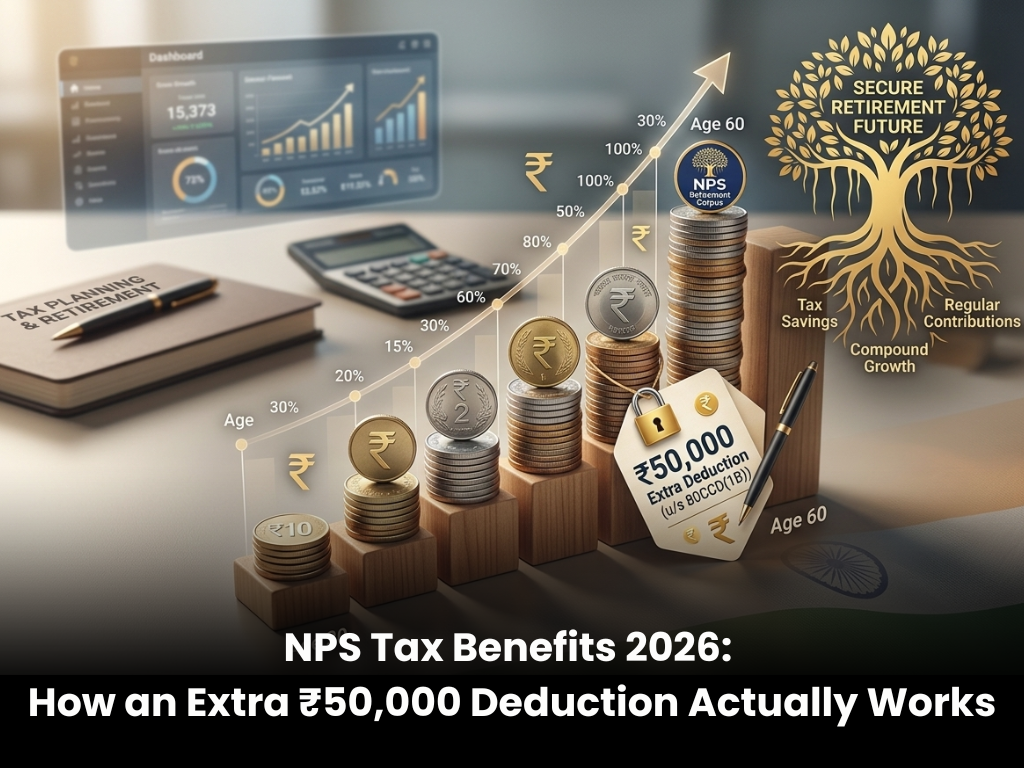
NPS provides an additional deduction of up to ₹50,000 under Section 80CCD(1B). Importantly, this benefit sits outside the ₹1.5 lakh limit under Section 80C.
In simple terms, if an investor has already exhausted the standard tax-saving limit, contributing to an NPS Tier-I account can still provide another ₹50,000 deduction.
For someone in the 30% tax bracket, that translates to roughly ₹15,000 in tax savings each year. In the 20% bracket, the savings can be around ₹10,000 annually.
However, there is one important point.
This additional ₹50,000 deduction is available only under the old tax regime.
The Deduction That Works Even in the New Tax Regime
While most deductions disappear in the new tax regime, NPS has one provision that still survives.
This comes under Section 80CCD(2).
Under this rule, an employer can contribute a portion of the employee’s salary to the NPS account. The contribution can go up to 14% of basic salary plus dearness allowance, and the entire amount becomes tax-deductible.
Unlike Section 80C deductions, this benefit does not fall within the ₹1.5 lakh limit.
More importantly, it remains available in both the old and the new tax regimes.
Because of this, many tax planners recommend structuring part of an employee’s cost-to-company package as an employer NPS contribution.
The overall salary does not change. But the tax treatment improves.
For high-income employees, especially, this can reduce taxable income in a fairly efficient way.
How the Three NPS Deductions Work Together
From a tax planning perspective, NPS benefits are divided into three separate sections:
Section 80CCD(1)
Employee contribution to NPS within the ₹1.5 lakh limit under Section 80C.
Section 80CCD(1B)
Additional ₹50,000 deduction for NPS Tier-I contributions, available only under the old tax regime.
Section 80CCD(2)
Employer contribution to NPS is deductible up to 14% of salary and available in both tax regimes.
When used together under the old regime, these provisions can significantly increase the total deductible amount.
However, most taxpayers only use the first deduction and overlook the others.
NPS as a Retirement Tool — Not Just a Tax Saver
While the tax benefits are attractive, NPS was primarily designed to support long-term retirement savings.
The scheme invests across a mix of asset classes such as equities, government securities and corporate bonds. This diversification allows investors to build a retirement corpus gradually over time.
Another key feature is the lock-in period until the age of 60, which encourages disciplined saving.
This long lock-in is also the main reason some investors hesitate to allocate large sums to NPS. Compared with mutual funds or other market-linked products, liquidity is relatively limited.
Partial withdrawals are permitted, but only under specific circumstances such as medical emergencies, higher education or housing needs.
What Happens at Retirement
When an NPS subscriber reaches the age of 60, the accumulated corpus can be withdrawn according to specific rules.
Currently:
• Up to 60% of the corpus can be withdrawn tax-free as a lump sum
• At least 40% must be used to purchase an annuity
The annuity provides a regular pension income, which is taxed as normal income in the year it is received.
Because of this structure, NPS functions more like a pension system than a typical investment product.
Why March 31 Matters
With the financial year closing soon, taxpayers who want to claim the extra ₹50,000 deduction under Section 80CCD(1B) must contribute to their NPS Tier-I account before March 31.
Once the financial year ends, that deduction opportunity disappears for that year.
For individuals already close to the ₹1.5 lakh limit under Section 80C, this additional deduction can still provide a meaningful tax advantage.
At the same time, it helps strengthen long-term retirement savings.
A Small Adjustment That Can Improve Tax Planning
Many tax-saving strategies revolve around complex restructuring or aggressive financial planning.
NPS works differently.
In most cases, it simply requires understanding how the available deductions are structured.
By combining the standard ₹1.5 lakh deduction with the additional ₹50,000 NPS benefit, and potentially employer contributions, taxpayers can improve both tax efficiency and retirement planning.
For professionals reviewing their finances before the financial year closes, this often turns out to be one of the more practical adjustments available.
Not dramatic. But quietly effective.