
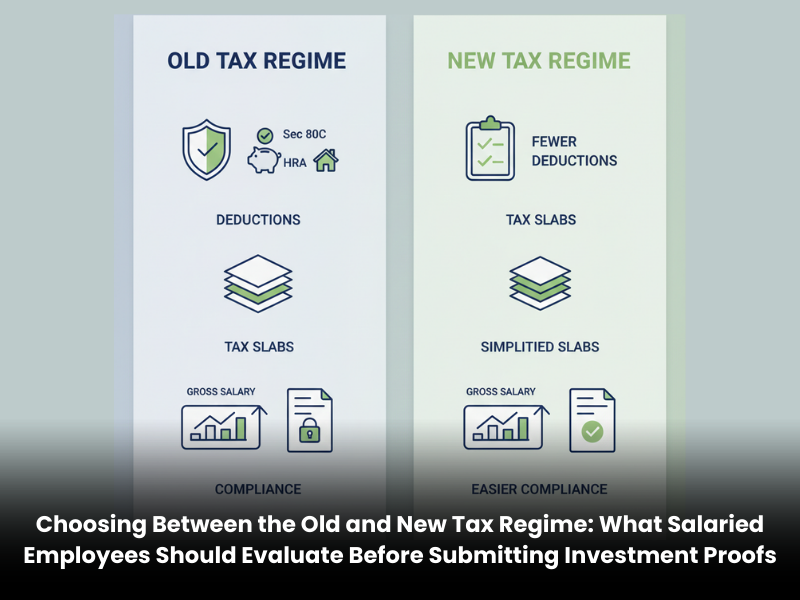
As employers begin the annual process of collecting investment declarations and proofs, salaried employees are required to indicate whether they wish to be taxed under the old tax regime or the new tax regime for TDS purposes.
This is not a mere administrative choice. The regime selected determines:
- How tax is deducted from salary during the year
- Whether deductions and exemptions are factored into monthly TDS
- The likelihood of refunds or additional tax payable at year-end
While the option can be changed later at the time of filing the income tax return, an informed decision at this stage helps avoid cash flow mismatches and last-minute adjustments.
Why the regime choice matters during proof submission
For salaried taxpayers, the employer computes and deducts tax at source based on the regime declared.
- Old tax regime
Employers allow eligible deductions and exemptions while calculating TDS, subject to documentary proof. - New tax regime
Employers apply lower slab rates but ignore most deductions and exemptions, resulting in simpler payroll processing.
Choosing incorrectly can lead to either excess TDS (and delayed refunds) or insufficient TDS (and tax payable later).
Key difference between the two regimes
Old tax regime: Deduction-driven
The old regime continues to be beneficial for employees who incur or plan structured expenses that qualify for tax relief, such as:
- House Rent Allowance (HRA)
- Home loan interest on self-occupied property (up to ₹2 lakh)
- Investments under Section 80C (up to ₹1.5 lakh)
- Health insurance premiums under Section 80D
- Leave Travel Allowance (LTA)
- Education loan interest
The effective benefit depends on the total value of deductions claimed, not merely on income level.
New tax regime: Rate-driven simplicity
The new regime offers:
- Lower slab rates
- Standard deduction of ₹75,000
- Limited additional deductions, such as:
- Employer’s contribution to NPS under Section 80CCD(2)
- Interest on home loan for let-out property
- Employer’s contribution to NPS under Section 80CCD(2)
Income up to ₹12 lakh does not attract tax under the revised slab structure, after factoring in the standard deduction.
However, most common exemptions and deductions are not available.
Understanding the break-even point
Whether one regime is better than the other depends on how much deduction you can legitimately claim.
As an illustration:
- For a salaried individual earning around ₹25 lakh, deductions of approximately ₹8 lakh or more typically tilt the balance in favour of the old regime.
- If total deductions are materially lower, the new regime often results in a lower overall tax outgo due to reduced slab rates.
This break-even threshold varies based on income level and deduction mix. There is no one-size-fits-all answer.
Who is better suited for each regime
Old regime may be preferable if you:
- Pay significant house rent or EMI on a home loan
- Actively invest in tax-saving instruments
- Claim multiple deductions across sections
- Have a stable and predictable deduction profile year-on-year
New regime may be preferable if you:
- Have limited or no deductions
- Prefer higher monthly take-home pay with minimal paperwork
- Do not want to lock money into tax-saving investments
- Are early in your career with a simpler financial structure
Documentation typically required under the old regime
Employees opting for the old regime are generally required to submit proofs such as:
- HRA
- Rent receipts
- Rent agreement
- Landlord’s PAN (if annual rent exceeds ₹1 lakh)
- Rent receipts
- Section 80C
- PF contribution statements
- Life insurance premium receipts
- ELSS, PPF, or tuition fee receipts
- PF contribution statements
- Health insurance (Section 80D)
- Premium payment receipts
- Premium payment receipts
- Home loan
- Interest certificate
- Principal repayment details
- Interest certificate
- LTA
- Travel tickets and expense proofs, as per company policy
- Travel tickets and expense proofs, as per company policy
Under the new regime, these proofs are generally not required since deductions are not considered for TDS.
Can the choice be changed later?
Yes. Salaried employees can:
- Choose one regime for TDS purposes during the year, and
- Switch to the other regime while filing the income tax return
However, changing later often results in refunds or additional tax payments, depending on how TDS was deducted.
Making a well-considered choice upfront helps align cash flows with actual tax liability.
What employees should do before finalising
Before submitting investment proofs or declarations:
- Compute tax liability under both regimes using realistic deduction figures
- Factor in certainty of deductions, not aspirational investments
- Consider cash flow needs, not just headline tax savings
The decision should be based on your income structure and deduction capacity, not on slab rates alone.
Closing note
The flexibility to choose between regimes exists to accommodate different financial profiles. However, the choice has practical implications throughout the year.
A few minutes spent evaluating both options before submitting investment proofs can prevent avoidable adjustments later and ensure that tax deduction aligns with your actual financial position.