
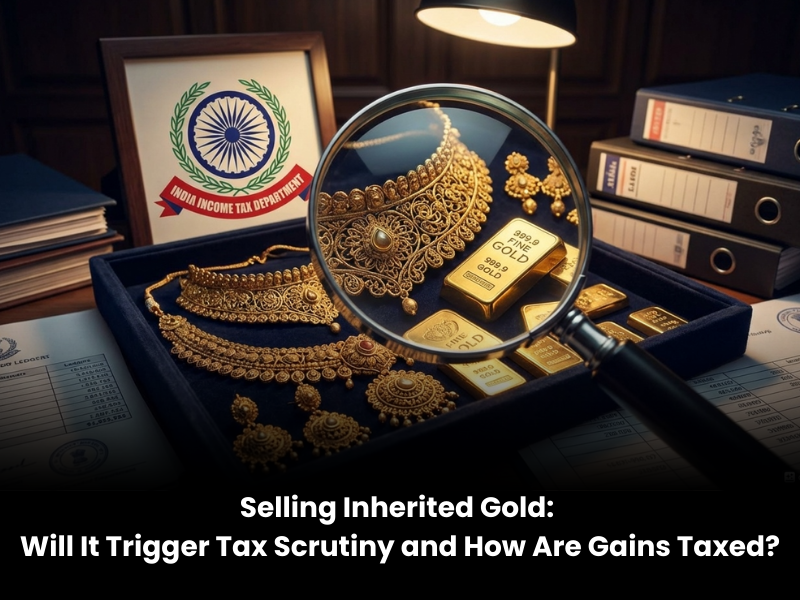
When a family discovers gold jewellery in a parent’s locker after their passing, the first concerns usually relate to tax implications, documentation and whether selling the jewellery could lead to scrutiny. For most taxpayers, the key considerations are the reasonableness of the jewellery held and how capital gains will be calculated when the jewellery is sold.
Will selling inherited gold create tax issues?
In most cases, no, provided the quantity of jewellery appears reasonable based on the family’s background and financial circumstances. Factors that tax authorities typically consider include:
- whether the gold could reasonably have been acquired over the parent’s lifetime
- whether the family had taxable income
- whether the deceased spouse was a taxpayer
- whether any inheritance, gifts or family customs support the accumulation
- age and life circumstances of the deceased
- whether the amount is consistent with CBDT norms used in tax-search cases
If the jewellery appears consistent with normal household accumulation, the sale proceeds are unlikely to trigger questions.
However, issues may arise if the quantity is unusually large and cannot be linked to disclosed income or family circumstances. In such cases, the assessing officer may treat it as unexplained investment, attracting tax at 60% plus surcharge and cess, along with penalty proceedings.
How will the capital gains tax be computed?
Inherited gold jewellery is treated as a capital asset. When you sell it, capital gains tax applies – even though you did not purchase it yourself.
1. Determine the holding period
The holding period is combined:
- your mother’s holding period plus
- the period for which you held it after inheritance
If this combined period exceeds 24 months, the jewellery qualifies as a long-term capital asset.
2. Tax rate on long-term capital gains
For long-term capital assets, gains are taxable at:
- 12.5%, plus surcharge and cess
3. How to compute the cost of acquisition
Your cost is considered the original cost incurred by your mother.
If the jewellery was acquired before 1 April 2001, you are allowed to use the fair market value (FMV) as on 1 April 2001 as the cost for computing gains.
4. How to compute the taxable gain
Taxable Long-Term Capital Gain = Sale Price – (Cost of Acquisition or FMV as on 01-04-2001)
Indexation benefit does not apply under the current rules for such assets.
If the gold cannot be explained
If you are unable to demonstrate that your mother could reasonably have accumulated the jewellery during her lifetime, the tax authorities may classify it as unexplained investment under Section 69A.
This attracts:
- 60% tax, plus
- surcharge and cess, and
- possible penalty proceedings
This typically applies only where the jewellery is excessive and cannot be linked to any plausible source.
Bottom line
- Selling inherited gold normally does not create tax problems if the jewellery appears reasonable for the family.
- Long-term capital gains tax at 12.5% will apply if the combined holding period exceeds 24 months.
- If the jewellery is very large and cannot be explained, authorities may treat it as unexplained income and levy higher tax and penalty.