
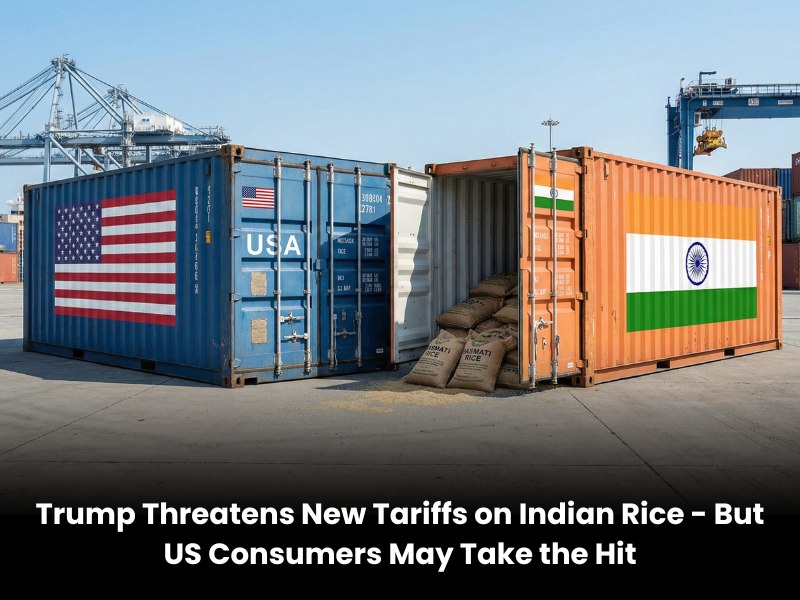
US President Donald Trump has renewed threats of additional tariffs on Indian rice, accusing India of “dumping” cheap rice into the US market and undercutting American farmers. Speaking at a White House event on December 8, 2025, he asked why Indian rice could enter the US “without higher tariffs,” adding, “We’ll take care of it.”
Indian Rice Already Faces High Duties
During the roundtable, Trump linked low US rice prices to imports from India, Thailand and Vietnam.
In reality, Indian rice already attracts 50 – 53% US tariffs.
Industry experts say any fresh tariffs would:
- raise US consumer prices, not Indian export volumes
- have minimal impact on India’s export strategy
- offer political signalling rather than immediate policy change
The Indian Rice Exporters Federation (IREF) noted that India’s diversified markets limit US leverage.
India’s Rice Export Scale: The Numbers
India remains the world’s largest rice exporter.
FY2024–25 (Apr 2024–Mar 2025):
- Total exports: 20.1 million tonnes (MT)
- Export value: $12.95 billion (₹1,14,802 crore)
- Growth: up 20% over FY23–24
- By March 25, 2025, India had already shipped 19.86 MT, beating last year’s full total of 16.36 MT.
Breakdown:
- Basmati:
- 6.07 MT
- ₹50,312 crore ($5.87B)
- Volume up 15.7% YoY
- Non-Basmati:
- ~14 MT
- ~$7.08B
Where India’s Rice Goes
India exports rice to 172+ countries.
- Basmati: Saudi Arabia, Iran
- Non-Basmati: Africa, Southeast Asia
- US share: $392M (just 3% of India’s total rice exports)
FY25–26 projections:
- 23.5 MT exports (16% increase)
- 26 new markets added
Top global importers include China, Saudi Arabia, the US, Iran and the Philippines.
Why Tariffs Won’t Hurt India Much
India’s export strength is supported by:
- high production
- strong basmati demand
- diversified markets
- WTO-compliant export policies
- new market exploration (Latin America, Africa, CIS nations)
Even after US duties, India remains the world’s top supplier due to competitiveness and product uniqueness.
Impact on US Consumers: Immediate Price Pain
US tariffs have already increased retail prices:
- A 10-lb bag of Indian rice now costs $18 – 19, up from $13 – 14.
Basmati’s aroma, elongation and cooking profile cannot be replicated by local US varieties, meaning consumers – especially South Asian households – have limited substitutes.
Historical Context and Future Outlook
Post-Green Revolution, India’s rice exports have grown steadily:
| Year | Total Exports |
| FY21 | 17.66 MT (4.63 MT basmati; 13.03 MT non-basmati) |
| FY24 | 16.36 MT |
| FY25 | 20.1 MT |
| FY26E | 23.5 MT |
A surplus crop, rising demand and premiumisation (organic, GI-tagged varieties) all support the outlook.
Final View
Trump’s rhetoric plays well politically, but:
- New tariffs would increase US retail prices
- India would redirect exports with minimal disruption
- Global basmati demand keeps India firmly in the lead
India’s rice economy remains resilient, diversified and globally competitive – even amid tariff noise.