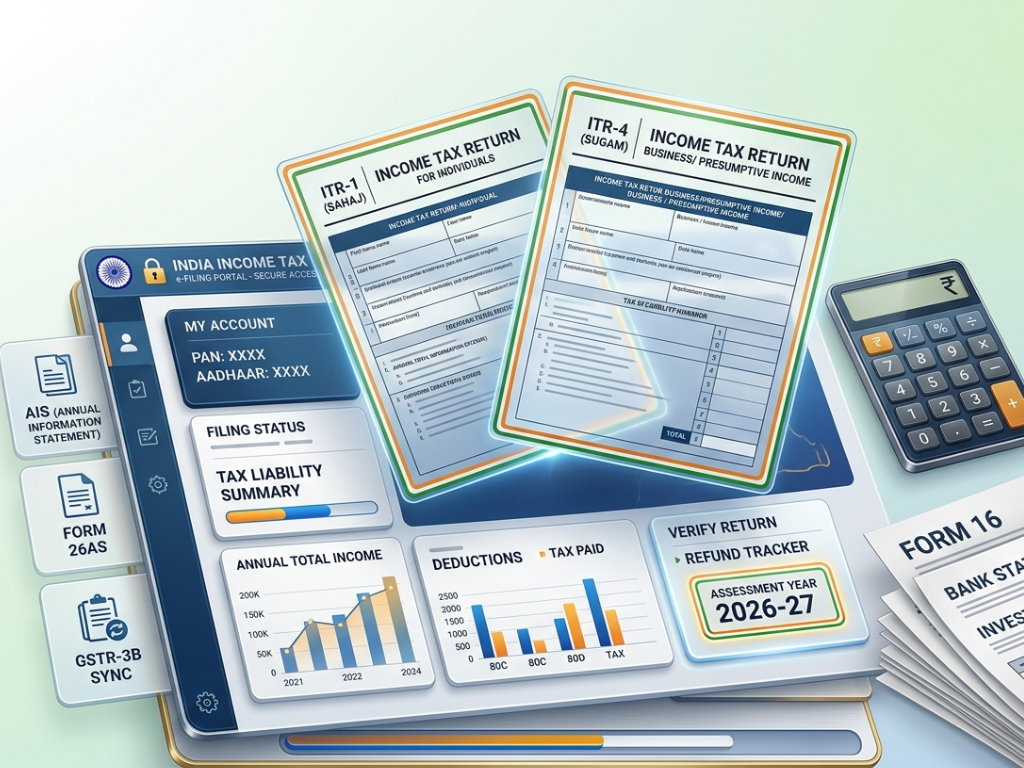
The Income Tax Department has notified the Income Tax Return (ITR) forms for Assessment Year 2026–27, formally beginning the annual return filing cycle for taxpayers across India.
The department has also released Excel utilities for ITR-1 and ITR-4, allowing taxpayers to prepare and validate returns offline before uploading them through the e-filing portal.
Early release of forms and utilities is expected to help taxpayers complete reconciliation and filing with fewer last-minute errors, particularly in cases involving salary income, TDS credits and AIS reporting.
What has been notified for AY 2026–27
The notified forms include:
- ITR-1 to ITR-7
- ITR-U for updated returns
Most salaried individuals are expected to file either ITR-1 or ITR-2, depending on the nature of income and eligibility conditions.
Taxpayers using presumptive taxation or reporting business income may need to use ITR-3 or ITR-4 based on the applicable framework.
The release of offline Excel utilities for ITR-1 and ITR-4 allows users to:
- prepare returns offline
- validate entries before submission
- generate upload-ready JSON files for portal filing
Which ITR form applies to whom
ITR-1
Applicable to resident individuals with:
- income up to ₹50 lakh
- salary or pension income
- one house property
- income from other sources within prescribed limits
ITR-2
Applicable to individuals and HUFs not having income from business or profession.
This form is generally used where taxpayers have:
- capital gains
- multiple house properties
- foreign assets or income
- income exceeding conditions prescribed for ITR-1
ITR-3
Applicable to individuals and HUFs earning income from business or profession.
ITR-4
Applicable to individuals, HUFs and eligible firms opting for presumptive taxation schemes, subject to prescribed conditions and turnover limits.
Selecting the incorrect form can lead to defective return notices or delays in processing.
Filing process and documentation
Before filing returns, taxpayers should reconcile key documents including:
- Form 16
- Form 26AS
- Annual Information Statement (AIS)
- TDS details
- capital gains statements
- interest and investment records
Returns can then be filed through the Income Tax e-filing portal using PAN-linked login credentials.
Once submitted, the return must be verified through Aadhaar OTP, net banking or other permitted verification methods. Filing is treated as incomplete until verification is completed.
Why reconciliation has become more important
The compliance environment has become increasingly data-driven.
Information reflected in AIS, Form 26AS, TDS returns, brokerage statements and employer filings is now cross-verified automatically during processing.
Even minor inconsistencies in:
- income reporting
- TDS claims
- capital gains disclosure
- interest income
can result in delayed refunds, processing flags or notices seeking clarification.
For salaried individuals, the most common issues typically arise from:
- unreported interest income
- mismatch in TDS credits
- incorrect form selection
- omission of secondary income sources
What this means for businesses and professionals
For CA firms and tax professionals, early availability of forms and utilities allows:
- smoother filing workflows
- better reconciliation planning
- identification of high-risk mismatch cases early in the cycle
Businesses also benefit from earlier payroll reconciliation and improved coordination between finance, HR and compliance functions.
In practice, early preparation reduces pressure closer to filing deadlines and lowers the likelihood of correction filings later.
Key takeaway
The notification of ITR forms for AY 2026–27 marks the start of the annual compliance cycle, but filing accuracy is likely to matter more than filing speed.
Taxpayers who reconcile income records early, select the correct form and ensure consistency across reporting systems are generally less likely to face refund delays or compliance notices during assessment.