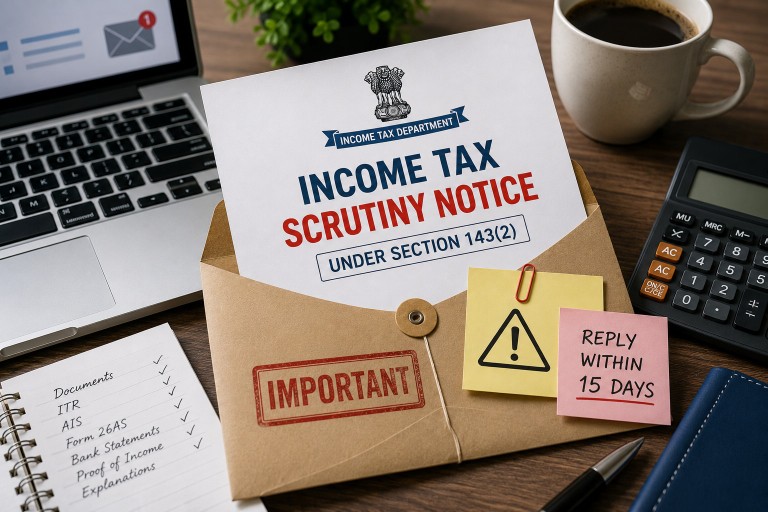
Receiving an income tax notice can be unsettling, but not every notice indicates a penalty or wrongdoing. One such notice is issued under Section 143(2) of the Income-tax Act, which is sent when the Income Tax Department selects a taxpayer’s Income Tax Return (ITR) for detailed scrutiny.
The department has been issuing electronic scrutiny notices through SMS, email and the Income Tax e-filing portal, asking taxpayers to explain certain transactions or provide supporting documents.
Understanding why you received the notice and responding correctly within the prescribed timeline can help ensure a smooth assessment process.
Why This Matters
A Section 143(2) notice is your opportunity to explain the information reported in your ITR. Ignoring the notice or submitting an incomplete response could lead to further inquiries or an adverse assessment.
Responding with accurate explanations and supporting documents within the specified deadline can help the assessment conclude smoothly.
What Is a Section 143(2) Scrutiny Notice?
A notice under Section 143(2) is issued when the Assessing Officer selects your Income Tax Return for detailed examination.
The purpose is to verify whether the income, deductions, exemptions and other details reported in your return are accurate. The department may ask for additional information or supporting documents before completing the assessment.
Receiving this notice does not automatically mean there is tax evasion or wrongdoing. It simply means the return requires further verification.
What Information Does the Notice Contain?
A Section 143(2) notice generally includes:
- PAN of the taxpayer
- Assessment Year
- Name and address
- Date of issue
- Details of the scrutiny proceedings
- Information and documents required
- Deadline for submitting the response, which is often around 15 days from the date of issue
Taxpayers should read the notice carefully to understand exactly what information has been requested.
Common Reasons for Receiving a Scrutiny Notice
The Income Tax Department may issue a scrutiny notice for several reasons, including:
- Mismatch between income reported in the ITR and the Annual Information Statement (AIS)
- Differences between Form 26AS, Form 16 and the income disclosed in the return
- High-value financial transactions requiring verification
- Unreported cryptocurrency transactions
- Inadequate response to an earlier tax notice
- Other discrepancies identified during return processing
The exact reason will depend on the taxpayer’s individual case.
How to Check a Section 143(2) Notice Online
You can view your notice through the Income Tax e-filing portal by following these steps:
- Log in using your PAN, Aadhaar or User ID.
- Go to Pending Actions.
- Select e-Proceedings.
- Click For Your Action.
- Open View Notice/Order.
- Download and carefully review the notice.
How to Respond Online
Once you understand the information being requested, you can submit your reply through the e-filing portal.
The process generally involves:
- Log in to the Income Tax e-filing portal.
- Navigate to Pending Actions > e-Proceedings.
- Open the notice and review every query carefully.
- Click Submit Response.
- Prepare a point-wise explanation for each query.
- Upload the required supporting documents.
- Review the response before submission.
- Submit the response and save the acknowledgement number for future reference.
Taxpayers can submit either:
- A complete response if all documents are available.
- A partial response if additional documents need to be uploaded later.
Documents Should Meet Portal Requirements
Before uploading documents, ensure they meet the portal’s specifications.
Generally, documents should:
- Not be password protected.
- Be properly named without spaces or special characters (except hyphens and underscores).
- Be scanned in black and white.
- Use A4 or letter-size pages.
- Combine multiple pages into a single file where possible.
- Remain within the maximum file size limit of 20 MB.
Following these requirements can help avoid upload errors.
What Happens If You Ignore the Notice?
Failing to respond within the prescribed timeline may result in the Assessing Officer completing the assessment based on the information available with the department.
This could potentially lead to additional tax demands or further proceedings if the department is not satisfied with the available information.
Final Takeaway
A Section 143(2) scrutiny notice should not be viewed as a penalty. It is part of the Income Tax Department’s verification process to ensure the information reported in your return is accurate.
If you receive one, review the notice carefully, understand the specific queries, gather all relevant supporting documents and submit a complete, point-wise response within the prescribed deadline. Where the issues involve complex transactions or technical tax matters, consulting a qualified tax professional can help ensure an accurate and timely response.