


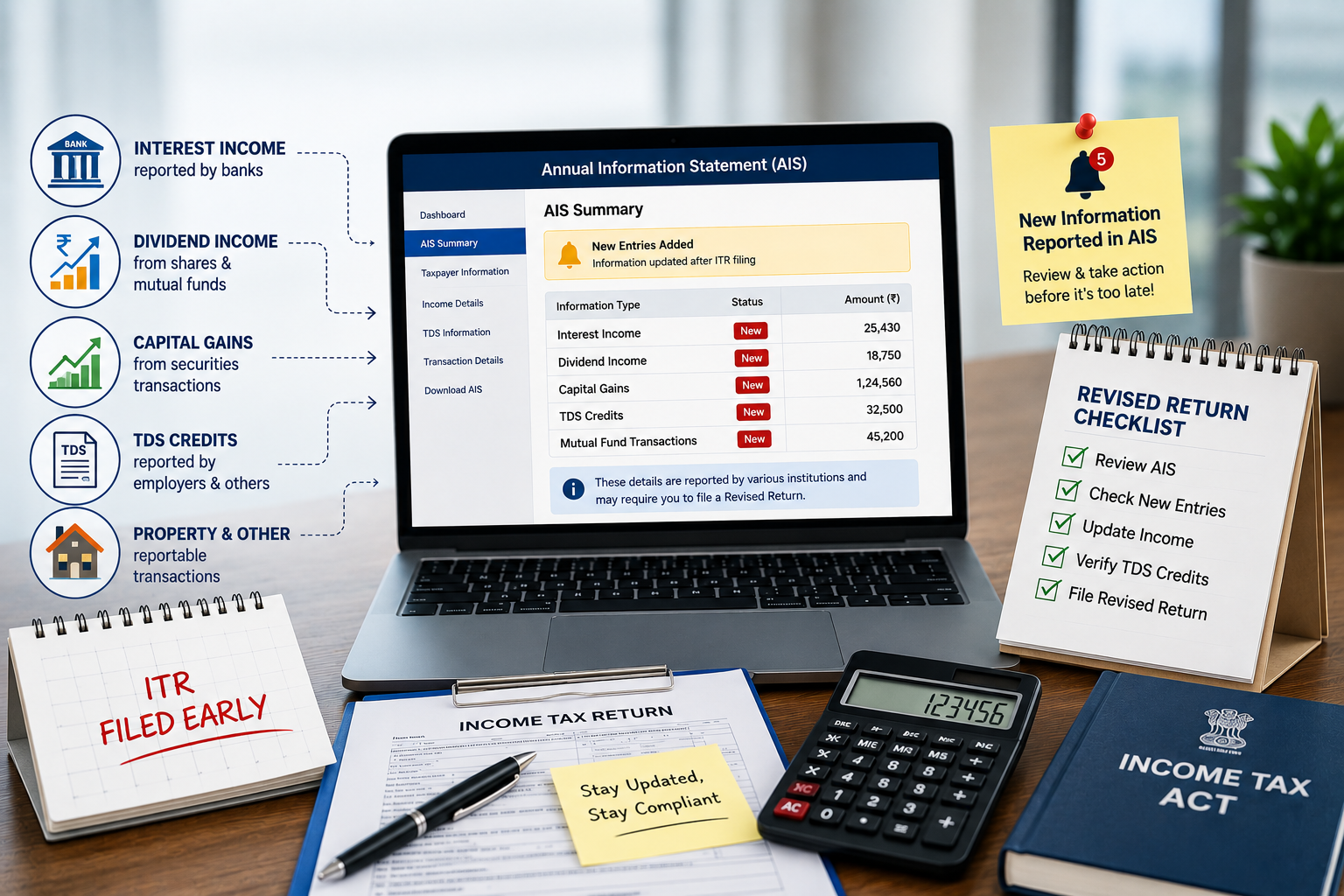
Many taxpayers prefer filing their Income Tax Returns (ITRs) as soon as the filing utilities become available. Early filing helps avoid last-minute complications and can result in faster processing of refunds. However, taxpayers should be aware that filing an ITR early does not necessarily mean that all financial information has already been captured by the Income Tax Department’s systems.
As reporting by banks, employers, mutual fund houses, and other financial institutions continues throughout the year, new entries may appear in a taxpayer’s Annual Information Statement (AIS) even after the original return has been filed. In such situations, filing a revised return may become necessary.
Why Are More Taxpayers Filing Revised Returns?
According to tax experts, the increasing number of revised returns is closely linked to the expanding scope of information captured by the Income Tax Department.
Today, taxpayers’ financial data is collected from multiple reporting entities and integrated into the department’s reporting systems. Since this information is often uploaded in phases, taxpayers who file their returns early may later discover additional entries that were not available at the time of filing.
As a result, revised returns are becoming increasingly common and are often filed to ensure that the return accurately reflects all reported income and transactions.
What Information Does the AIS Capture?
The Annual Information Statement (AIS) serves as a comprehensive record of a taxpayer’s financial activities during the year.
The AIS may contain information relating to:
- Salary income reported by employers
- Interest earned on savings accounts and fixed deposits
- Dividend income from shares and mutual funds
- Purchase and sale of securities
- Mutual fund transactions
- Property purchase and sale transactions
- Foreign remittances
- Tax Deducted at Source (TDS) information
- High-value financial transactions reported by specified entities
Since much of this information is reported by third parties, updates may continue to appear in the AIS even after an ITR has been filed.
Why Can New Entries Appear After Filing?
Many financial institutions submit their final reports only after the financial year ends.
For example:
- Banks may subsequently report additional interest income.
- Employers may complete fourth-quarter TDS filings at a later stage.
- Mutual fund houses and brokers may update transaction details.
- Dividend information may be reported after the return has already been filed.
As these updates are incorporated into the AIS, taxpayers may notice income or transactions that were not reflected in their original return.
Till when the taxpayer can file the revised return for FY 2025-26?
The due date for filing a revised return for FY 2025 – 26 has been extended to 31 March 2027 or before the completion of assessment, whichever is earlier.
When Should a Taxpayer Consider Filing a Revised Return?
A revised return should be considered when newly reflected AIS information impacts the accuracy of the original ITR.
Common situations include:
Unreported Interest Income
Interest from savings accounts, fixed deposits, or recurring deposits appearing in AIS after filing.
Additional Dividend Income
Dividend receipts not included in the original return.
Missing Capital Gains Transactions
Sale of shares, mutual funds, or other securities reported later by brokers or depositories.
Additional TDS Credits
New TDS entries becoming visible after filing.
Property or Other Reportable Transactions
Transactions that require disclosure but were not reflected in the original return.
If such discrepancies are identified, filing a revised return can help ensure compliance and reduce the risk of future notices.
How Can Taxpayers Avoid Future Revisions?
Before filing an ITR, taxpayers should take the following precautions:
Review the AIS Thoroughly
Verify all income and transaction details appearing in the statement.
Check Form 26AS
Ensure that TDS and tax payment details are correctly reflected.
Reconcile Financial Records
Compare AIS information with bank statements, salary records, investment statements, and other financial documents.
Verify Capital Gains Reports
Review statements provided by brokers and mutual fund platforms.
Avoid Filing Too Early
Where possible, taxpayers may consider waiting until major reporting entities have completed their reporting obligations.
Revised Returns Are Becoming a Normal Part of Tax Compliance
The Income Tax Department’s technology-driven reporting framework has significantly improved transparency and data matching capabilities. While this benefits tax administration, it also means that taxpayers must pay closer attention to information reflected in AIS and Form 26AS.
The growing number of revised returns is not necessarily an indication of taxpayer error. Rather, it reflects a tax ecosystem where financial information continues to be updated and reconciled long after the financial year has ended.
Conclusion
Taxpayers who file their returns early should continue monitoring their Annual Information Statement even after submission. Newly reported income, transactions, or TDS credits may require corrections to the original return.
Regularly reviewing AIS and Form 26AS before and after filing can help taxpayers maintain accurate records, avoid unnecessary notices, and ensure smooth tax compliance.
Disclaimer
This article is intended for informational purposes only and should not be construed as tax, legal, or financial advice. Readers should consult a qualified Chartered Accountant or tax professional before filing or revising their Income Tax Return. Tax laws and compliance requirements are subject to change and should be verified with the latest notifications issued by the Income Tax Department.
