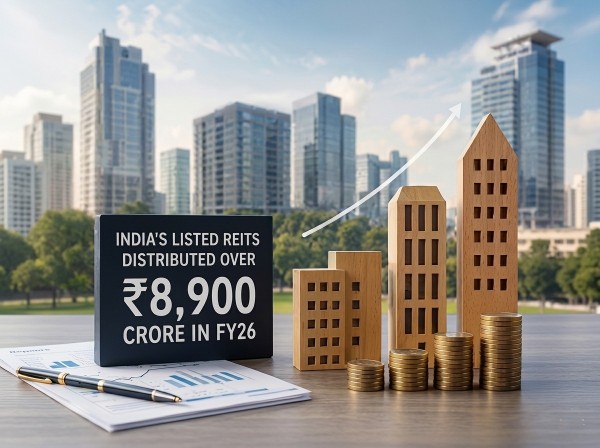
For investors seeking regular income from institutional-grade real estate, India’s listed Real Estate Investment Trust sector has delivered a notable milestone in FY26.
The latest distribution data released by the Indian REITs Association has confirmed a 50% increase in payouts to unitholders compared to the previous year, with the sector’s overall scale continuing to expand across assets, market capitalisation and investor base.
While the annual figures reflect a strong year of operating performance, they also offer a useful lens through which to understand how the REIT platform has matured and what it now represents within India’s capital markets.
The distribution data behind the headline
India’s five publicly listed REITs distributed more than Rs 8,900 crore to unitholders in FY26, a rise of over 50% compared to the previous year.
On its own, a single year’s payout figure does not capture the full picture. The more meaningful context lies in the trajectory.
Since inception, these five REITs have cumulatively distributed over Rs 31,700 crore to unitholders, a figure that reflects consistent cash flow generation across multiple market cycles and underlines the sector’s growing relevance within India’s investment landscape.
How REITs generate and distribute income
REITs pool investor capital to acquire and manage rent-yielding commercial properties. Under SEBI regulations, they are required to distribute at least 90% of their net cash flows to unitholders on a regular basis.
The income distributed to unitholders can come from two primary sources:
- rental earnings from the underlying commercial properties managed by the REIT
- interest income from loans extended by the REIT to its underlying properties or special purpose vehicles
While the structure is governed by regulation, the underlying principle is straightforward: REITs are designed to pass through the income generated by institutional real estate directly to investors, providing a steady and relatively predictable income stream.
Payments are typically made twice a year, though some REITs distribute on a quarterly basis, with amounts credited directly to the unitholder’s linked bank account.
Why the FY26 numbers are significant
The 50% increase in distributions is not simply a reflection of more assets under management. It points to stronger operating performance from the underlying portfolio and the sector’s ability to sustain and grow cash flows.
At present:
- The five listed REITs collectively manage over 187 million square feet of Grade A office and retail real estate
- Total gross asset value of the Indian REIT market stood at over Rs 2.72 lakh crore as of Q4 FY26
- Combined market capitalisation of the sector was over Rs 1.7 lakh crore as of May 22, 2026
These numbers place the Indian REIT market in a different category compared to where it stood even three to four years ago.
What this means for investors and financial planning
REIT distributions influence more than just quarterly income credits for unitholders. They are relevant across several dimensions of financial planning:
- regular income planning for retail and institutional investors
- portfolio diversification away from purely equity or debt instruments
- tax planning, given the varied treatment of dividend, interest and return-of-capital components in REIT distributions
- retirement income strategy for investors seeking yield with relatively stable underlying assets
For advisors working with clients who hold REIT units or are evaluating the asset class, the FY26 distribution data provides a concrete benchmark for income projections and portfolio planning discussions.
A broader signal for commercial real estate
Beyond investor returns, REIT distribution growth also reflects the underlying health of India’s Grade A commercial real estate market.
Sustained distribution increases typically indicate:
- healthy occupancy levels across office and retail portfolios
- stable or growing rental income from tenants
- disciplined asset management and capital allocation by REIT managers
- continued demand from domestic and global occupiers for quality commercial space
For the broader economy, a growing REIT sector also signals deepening capital market infrastructure and increasing institutionalisation of real estate as an asset class.
Closing perspective
The FY26 distribution figures confirm that India’s listed REIT sector has crossed an important threshold in scale, consistency and investor reach.
A 50% increase in annual distributions, combined with a cumulative payout of over Rs 31,700 crore since inception, positions REITs as a credible income-generating platform within India’s investment ecosystem.
However, future distribution growth will depend on occupancy trends, rental rate movements, interest rate conditions and the pace of asset expansion across the five listed platforms.
Until those variables play out, the FY26 scorecard should be read as a strong year of delivery rather than a guaranteed trajectory going forward.