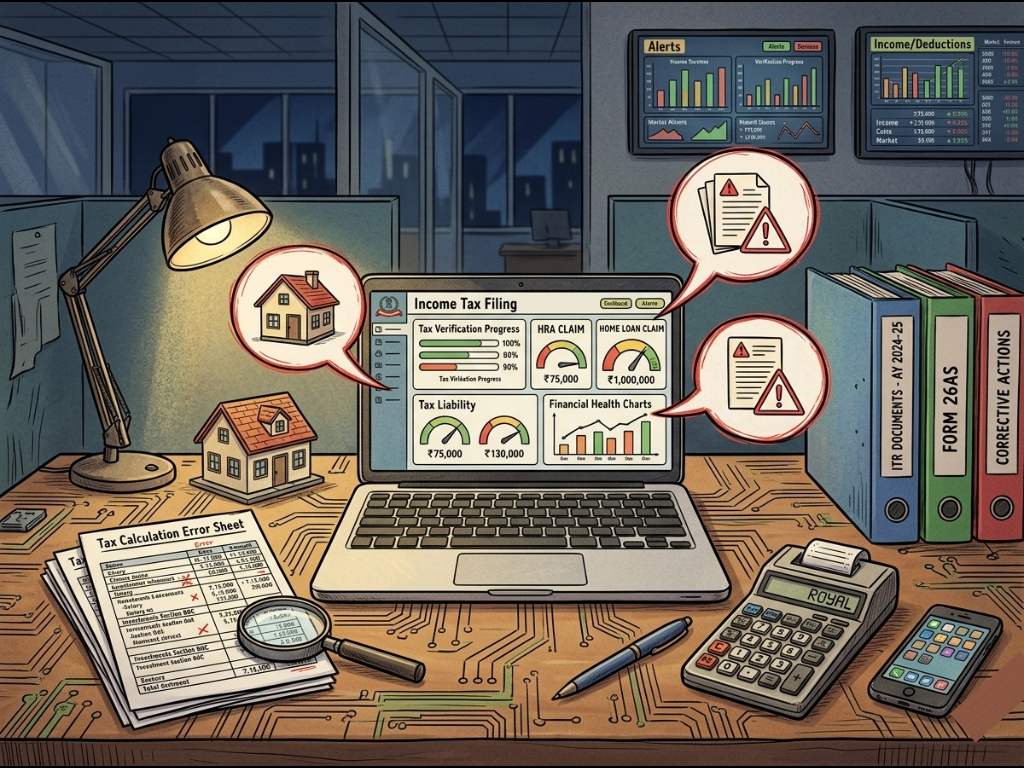
Errors in claiming House Rent Allowance (HRA) along with home loan benefits in Income Tax Returns (ITR) are among the most common filing issues faced by salaried taxpayers. While both benefits are legally available under the old tax regime, incorrect combinations or missing documentation can trigger tax mismatches, notices, or additional tax demands.
The Income Tax Department increasingly relies on automated data reconciliation through Form 26AS, AIS and employer filings, making it easier to detect inconsistencies between HRA claims, rent payments and home loan deductions.
However, not every dual claim is incorrect. The issue depends entirely on eligibility, documentation and actual living arrangements.
When HRA and Home Loan Benefits Can Be Claimed Together
Under the old tax regime, taxpayers may claim both HRA exemption under Section 10(13A) and home loan tax benefits under Section 24(b) and Section 80C.
This is allowed only in genuine cases such as living in a rented house while owning a property elsewhere, working in a different city from where the owned property is located, or staying on rent while an under-construction property is financed through a home loan.
In such cases, both benefits can coexist legally, provided proper documentation supports the claim.
Where Tax Problems Usually Arise
Issues typically emerge when claims are made without matching real-life conditions or supporting evidence.
Common red flags include claiming HRA while residing in a self-owned house, showing rent payments without a genuine landlord arrangement, or claiming HRA and home loan benefits for the same property without valid separation of use.
Mismatch between declared rent and actual bank transactions or missing rental agreements also increases scrutiny risk.
In such cases, the Income Tax Department may treat the return as incorrect, even if the error was unintentional.
What Happens If the Claim Is Incorrect
If discrepancies are identified, taxpayers may receive an intimation under Section 143(1) or a scrutiny notice seeking clarification.
Consequences may include additional tax demand, interest under Sections 234B and 234C, and in some cases penalties for incorrect reporting or misstatement of deductions.
Most cases, however, are resolved through clarification and corrected documentation rather than prolonged litigation.
How to Fix Errors in HRA and Home Loan Claims
If the return has already been filed but the mistake is identified, taxpayers still have correction options depending on timing.
Where the revision window is open, a revised return under Section 139(5) can be filed to correct HRA exemption, adjust home loan deductions, and remove overlapping claims.
If the revision window has closed, taxpayers may need to file an updated return under Section 139(8A) (ITR-U) within the permitted time limits, along with additional tax and interest if applicable.
In both cases, correction is considered more favourable than waiting for a departmental notice.
Documents Required for Correction or Scrutiny Response
Taxpayers should ensure supporting records are readily available, including rent agreements, rent receipts, bank transfer proof of rent payment, Form 12BB submitted to the employer, home loan interest certificate, and property ownership or possession documents.
These records play a critical role in validating whether claims were correctly made under applicable provisions.
Why This Matters for Taxpayers and Salaried Individuals
For salaried individuals, HRA and home loan benefits form a significant part of tax planning under the old regime. However, incorrect claims can quickly convert legitimate deductions into compliance issues.
With increasing data matching between employers, banks and the Income Tax Department, even minor inconsistencies can trigger automated notices.
This makes accurate classification and documentation essential, not optional.
Why This Matters for Tax Professionals and Advisory Support
For tax practitioners and CA firms, such cases highlight the importance of pre-filing review, especially where taxpayers have multiple housing-related claims.
Proper assessment of residential status, rent documentation and property ownership structure helps prevent avoidable notices and revision work later.
It also reduces compliance risk arising from incorrect or overlapping deduction claims.
Key Takeaway
HRA and home loan benefits can be claimed together, but only under clearly defined conditions backed by documentation.
Incorrect or unsupported claims may lead to tax notices, interest liability or return revision requirements.
In most cases, errors can be corrected through revised or updated returns, provided action is taken within prescribed timelines.