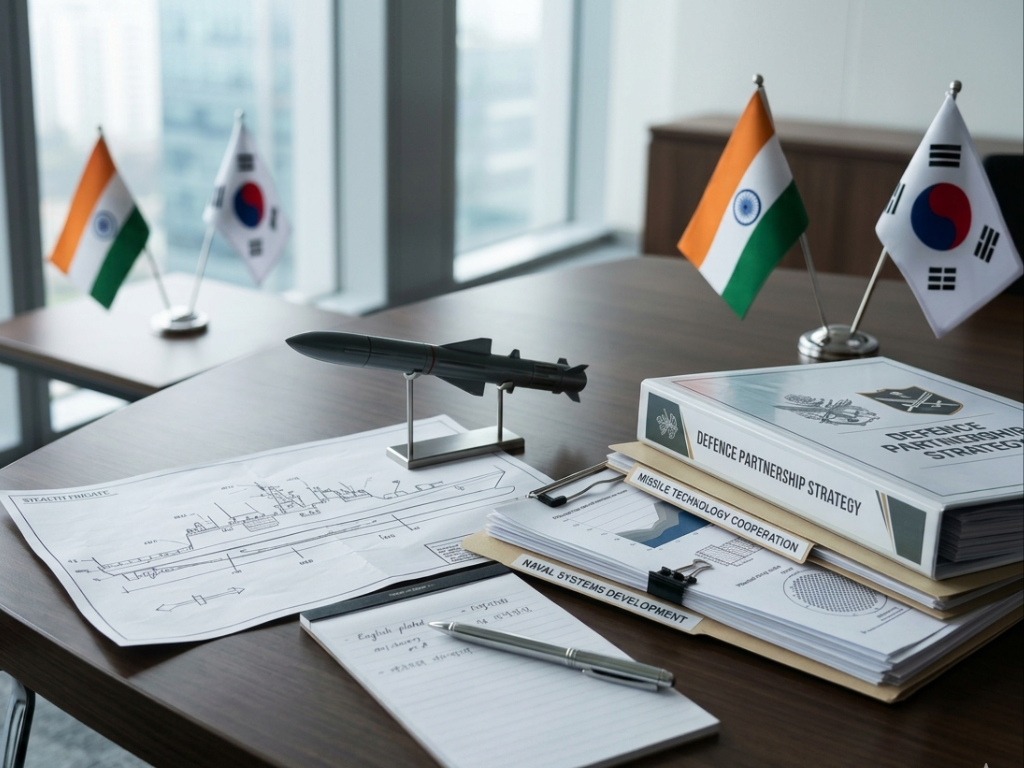
Defence Minister Rajnath Singh’s visit to South Korea this week comes at a time when India’s defence partnerships are becoming increasingly focused on technology transfer, domestic manufacturing and long-term strategic alignment.
For years, India’s defence relationship with South Korea remained relatively limited compared to partners such as Russia, France, Israel or the United States. That is beginning to change.
What started with artillery procurement has now expanded into discussions around missile systems, air defence platforms, naval technologies and joint defence development.
At the centre of this relationship is a shift in how India wants to build military capability: less dependence on outright imports and greater emphasis on co-development and manufacturing within India.
The K9 Vajra-T became the turning point
The most visible example of India–South Korea defence cooperation is the K9 Vajra-T artillery system.
The platform is based on South Korea’s K9 Thunder self-propelled howitzer and is manufactured in India by Larsen & Toubro in partnership with Hanwha Aerospace.
India placed its first order for 100 K9 Vajra-T systems in 2017. The platform later gained attention after being deployed in Ladakh during the military standoff with China.
Originally designed for different terrain conditions, the system reportedly performed effectively in high-altitude environments, which strengthened confidence within the Indian Army.
That operational success helped push the relationship into a broader strategic space.
India later cleared additional procurement of K9 systems, while discussions increasingly moved towards localisation and technology transfer rather than pure procurement.
Why South Korea is becoming important for India
India’s interest in South Korean defence systems is driven by a combination of practical and strategic reasons.
South Korean platforms are generally seen as:
- technologically advanced
- comparatively cost-effective
- open to manufacturing partnerships and localisation
That last point matters significantly.
Unlike some defence suppliers that remain restrictive on technology sharing, South Korean firms have shown greater willingness to participate in local manufacturing and industrial collaboration.
This aligns closely with India’s:
- Make in India
- Aatmanirbhar Bharat
- defence indigenisation strategy
The objective is no longer only to buy military equipment, but to gradually build domestic manufacturing capability around it.
The partnership is now expanding beyond artillery
The relationship is increasingly moving into:
- anti-aircraft systems
- missile defence
- naval technologies
- aerospace collaboration
- autonomous and AI-driven defence systems
One area under discussion is the K30 Biho air defence system, designed to counter low-altitude aerial threats such as drones and helicopters.
India has also explored collaboration on light tank platforms suited for mountainous terrain and high-altitude deployment.
Beyond land systems, naval cooperation is becoming increasingly important.
South Korea’s shipbuilding expertise and submarine technologies are relevant for India’s long-term maritime strategy in the Indo-Pacific region, especially as regional naval competition intensifies.
What KIND-X signals
One of the more important developments is the proposed Korea–India Defence Accelerator, or KIND-X.
Unlike earlier defence relationships built mainly around imports, KIND-X reflects a more long-term approach centred on:
- co-development
- defence startups
- AI-led military systems
- advanced manufacturing
- joint innovation ecosystems
This signals a shift from buyer-seller dynamics towards collaborative capability building.
For India, this is strategically important because future military competition is increasingly expected to depend on:
- autonomous systems
- electronic warfare
- AI-enabled platforms
- missile defence integration
- advanced surveillance capability
Countries that only import finished systems may eventually face technological dependence without domestic capability creation.
The geopolitical context matters
The timing of deeper India–South Korea cooperation is not accidental.
South Korea faces growing pressure from:
- North Korea’s missile and nuclear programme
- rising China-related regional tensions
- broader instability in the Indo-Pacific region
India, meanwhile, continues managing:
- border tensions with China
- maritime competition in the Indian Ocean
- the need to diversify defence suppliers
This creates a natural strategic overlap between the two countries.
Both nations are increasingly trying to reduce dependence on any single security partner while strengthening domestic industrial capability.
What this means for India’s defence strategy
The larger shift here is not about one artillery system or one defence deal.
It reflects how India’s defence procurement model is changing.
The focus is gradually moving from:
- importing finished platforms
to - building long-term industrial partnerships tied to manufacturing, technology transfer and local capability creation
If ongoing discussions around missile systems, naval technologies and advanced defence manufacturing continue progressing, South Korea could emerge as one of India’s most significant defence collaborators in Asia over the next decade.
Closing perspective
India’s defence relationship with South Korea is no longer limited to procurement contracts.
It is increasingly becoming part of a broader strategic effort involving manufacturing, technology sharing and long-term defence capability development.
For India, the real value lies not only in acquiring military hardware, but in building the industrial and technological ecosystem required to reduce future dependence on external suppliers.