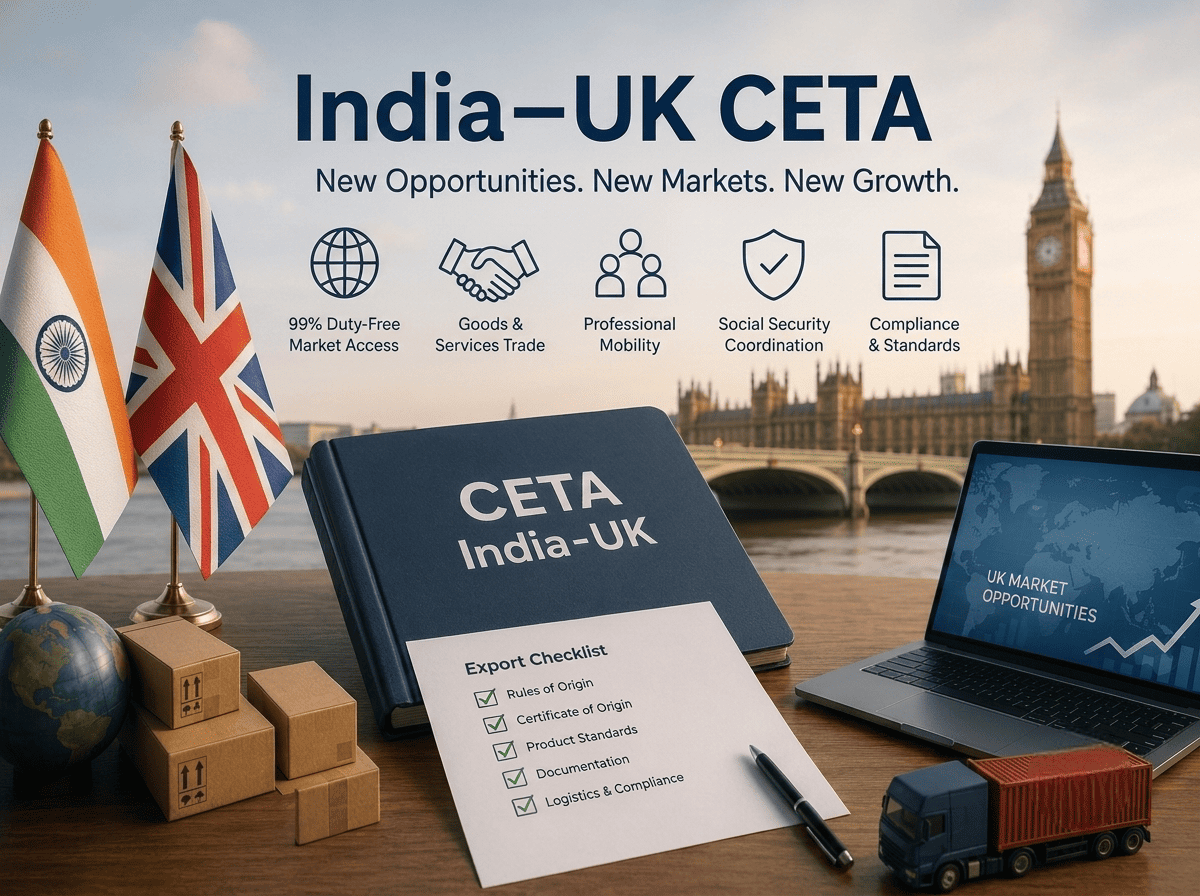
The India–UK Comprehensive Economic and Trade Agreement (CETA), which came into force on 15 July 2026, marks one of India’s most significant bilateral trade agreements in recent years.
Much of the discussion around the agreement has focused on tariff reductions and export opportunities. While these are important, the practical impact for businesses goes well beyond lower customs duties.
For exporters, manufacturers and service providers, the agreement creates new commercial opportunities—but only if businesses understand the compliance, documentation and market-entry requirements that accompany preferential access.
What does the agreement change?
The agreement provides Indian exporters with duty-free access on almost 99% of current exports to the United Kingdom. This significantly improves the competitiveness of Indian products in one of the world’s largest consumer markets.
In addition to trade in goods, the agreement also covers:
- services
- digital trade
- telecommunications
- intellectual property
- government procurement
- small and medium enterprises (SMEs)
- sustainability and professional mobility
This makes the agreement broader than a conventional tariff-reduction arrangement.
Which sectors are likely to benefit?
The immediate opportunities are expected to be strongest for labour-intensive export sectors.
These include:
- textiles and garments
- leather and footwear
- marine products
- gems and jewellery
- engineering goods
- auto components
- chemicals
- pharmaceuticals
- processed food
- toys and sports goods
Several of these products previously attracted substantial import duties in the UK. The removal of those tariffs improves price competitiveness for Indian exporters.
However, lower tariffs alone do not guarantee export growth.
Businesses must still compete on quality, pricing, reliability and delivery standards.
Services may become equally important
While merchandise exports receive considerable attention, the agreement also expands opportunities for Indian service providers.
The UK has made commitments across 137 service sub-sectors, including:
- information technology
- engineering
- financial services
- consulting
- architecture
- education
- healthcare
- professional services
For companies operating in these sectors, the agreement creates a more predictable framework for cross-border business and professional engagement.
Professional mobility becomes easier—but not automatic
One of the widely discussed aspects of the agreement relates to the movement of professionals.
The agreement introduces more structured provisions for categories such as:
- business visitors
- intra-company transferees
- contractual service suppliers
- investors
- independent professionals
However, this should not be interpreted as unrestricted access to the UK labour market.
Professionals must continue to satisfy applicable immigration requirements, visa conditions, sponsorship norms and qualification standards.
The agreement improves predictability rather than creating automatic work rights.
Understanding the Double Contribution Convention (DCC)
Another important feature of the agreement is the Double Contribution Convention.
The DCC is designed to prevent eligible employees and employers from contributing simultaneously to social security systems in both India and the United Kingdom.
For eligible employees temporarily deputed from India to the UK, contributions may continue under India’s Employees’ Provident Fund framework for up to five years instead of requiring parallel contributions under the UK’s National Insurance system.
It is important to understand what this provision does not do.
The DCC is not:
- a new visa category
- an immigration concession
- an exemption available to every Indian working in the UK
- automatic access to UK pension benefits
It is a social security coordination mechanism intended to avoid duplicate contributions for eligible temporary assignments.
Compliance will determine who benefits
The agreement removes tariff barriers, but businesses must still satisfy several operational requirements before claiming preferential treatment.
Exporters should understand:
- rules of origin
- certificates of origin
- UK product standards
- customs documentation
- packaging and labelling requirements
- logistics arrangements
- payment and foreign exchange risks
Products qualify for preferential tariffs only if they satisfy the agreement’s origin requirements and the prescribed documentation is maintained.
For many first-time exporters, these compliance requirements may prove more challenging than identifying export opportunities.
What does this mean for MSMEs?
Small and medium enterprises stand to benefit significantly from improved market access.
However, many MSMEs face practical challenges in:
- certification
- export documentation
- quality compliance
- logistics
- overseas market development
Recognising this, the government has announced support mechanisms, including advisory services and digital platforms aimed at helping businesses understand and utilise the agreement more effectively.
For many smaller businesses, success will depend not only on the agreement itself but also on their ability to navigate export procedures confidently.
What businesses should do now
Companies planning to explore the UK market should begin by reviewing:
- product eligibility under the agreement
- applicable tariff concessions
- origin requirements
- certification obligations
- export documentation processes
- pricing strategy after tariff reductions
- distribution and logistics arrangements
Businesses already exporting to the UK should also reassess whether they can now improve pricing, expand product lines or strengthen competitiveness under the revised framework.
Closing perspective
The India-UK CETA creates one of the most significant export opportunities for Indian businesses in recent years. It improves market access across goods and services while providing a clearer framework for professional mobility and bilateral investment.
However, the agreement should be viewed as an opportunity rather than a guarantee of export growth.
For businesses, the next phase will be determined less by tariff reductions and more by execution—meeting quality standards, complying with origin requirements and building the operational capability needed to compete successfully in the UK market.