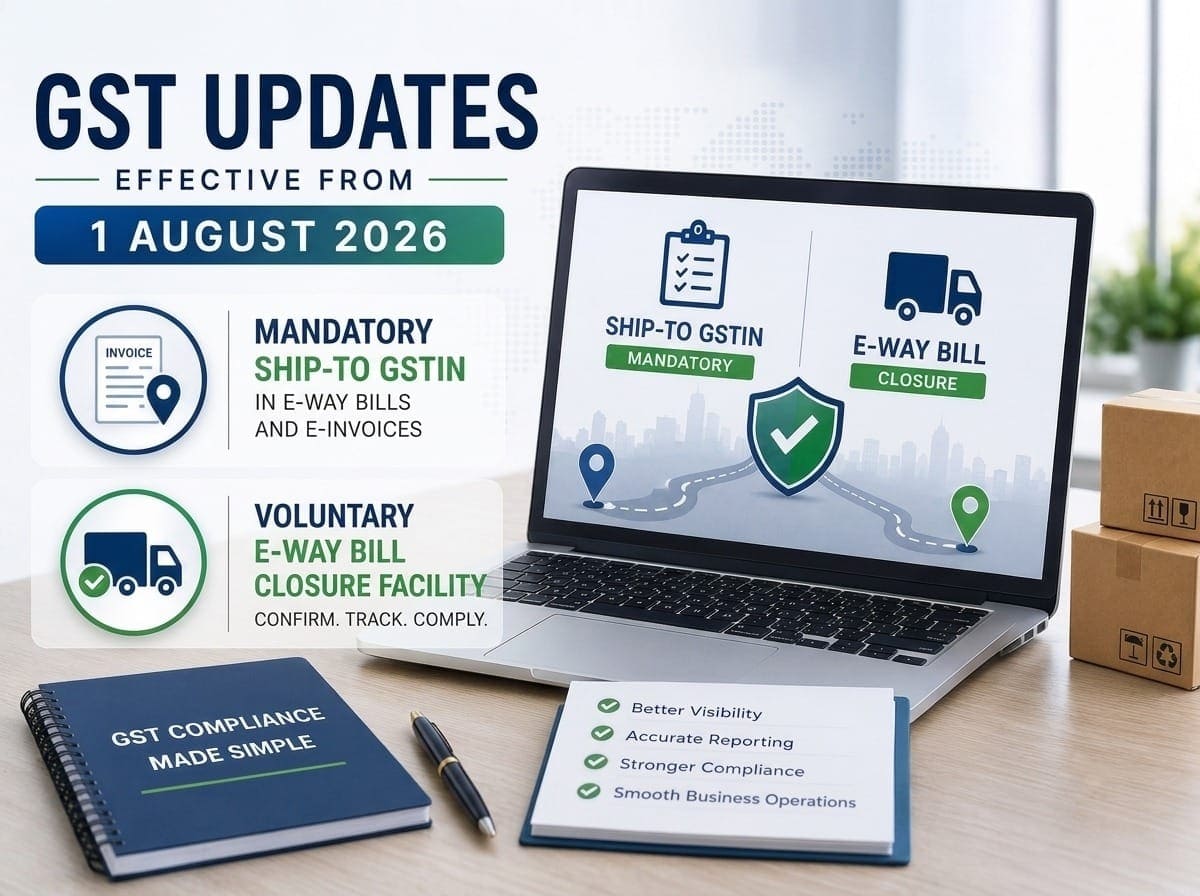
The Goods and Services Tax Network (GSTN) has announced two important updates to the e-Way Bill (EWB) and e-Invoice systems that will come into effect from 1 August 2026.
These changes are aimed at improving the tracking of goods, reducing reporting gaps, and strengthening GST compliance. The two key changes are:
- Mandatory reporting of the Ship-To GSTIN in specified transactions.
- Introduction of a Voluntary e-Way Bill Closure facility.
Let’s understand what these changes mean and how businesses should prepare.
1. Mandatory Ship-To GSTIN in e-Way Bills and e-Invoices
One of the biggest changes from 1 August 2026 is that the Ship-To GSTIN will become a mandatory field for applicable Bill-To/Ship-To transactions.
The objective is to improve visibility in complex supply chains and ensure that the movement of goods can be accurately tracked.
What is the Bill-To/Ship-To Model?
In a Bill-To/Ship-To transaction, the seller invoices one party but delivers the goods to another location as instructed by the buyer.
Example
- Company A sells goods to Company B.
- Company B asks Company A to deliver the goods directly to Company C.
- The invoice is issued in the name of Company B.
- However, the goods are physically delivered to Company C.
This is known as a Bill-To/Ship-To transaction.
Legal Position under the IGST Act
Under Section 10(1)(b) of the IGST Act, 2017, when goods are delivered to another person on the instructions of the buyer, the buyer (Bill-To party) is deemed to have received the goods.
Therefore:
- The invoice is issued using the buyer’s GSTIN.
- The delivery address is separately mentioned in the Ship-To section.
- The place of supply is determined based on the principal place of business of the Bill-To party.
What Changes from 1 August 2026?
Earlier, taxpayers could generate an e-Way Bill even if the Ship-To GSTIN field was left blank in many cases.
From 1 August 2026, this will no longer be possible.
Whenever an e-Way Bill is generated for a Bill-To/Ship-To transaction, entering the Ship-To GSTIN will be mandatory.
If this information is not provided, the portal will not allow the e-Way Bill to be generated.
What Should You Enter?
If the delivery location is GST registered
Enter the GSTIN of the actual delivery location.
If the delivery location is not GST registered
Examples include:
- Project sites
- Construction sites
- Warehouses without GST registration
- End consumers
In such cases, enter “URP” (Unregistered Person).
The GST portal will accept URP as a valid value.
This is particularly important because many businesses previously left this field blank when delivering goods to unregistered locations.
Export and Merchant Export Transactions
The advisory also clarifies how the Ship-To GSTIN should be reported in export-related transactions.
Export Transactions
Where goods are dispatched to an Indian port, Inland Container Depot (ICD), or another export-linked location for shipment outside India:
- Enter URP as the Ship-To GSTIN.
- Mention the actual destination address and PIN code of the port or export location.
Merchant Exporters
In merchant export cases:
- The Bill-To GSTIN will be that of the merchant exporter.
- The Ship-To GSTIN must also be provided.
- If the delivery location is unregistered, URP should be entered.
2. Voluntary e-Way Bill Closure Facility
GSTN has also introduced a new Voluntary e-Way Bill Closure feature.
Until now, once goods reached their destination, there was no option to officially confirm delivery on the GST portal.
Under the earlier e-way bill system the e-way bill remained active until it expired automatically or was cancelled.
This often created confusion in cases involving:
- Cancelled deliveries
- Returned goods
- Failed transportation
- Transactions that never concluded
The new closure facility allows businesses to officially mark an e-Way Bill as completed once the goods have been delivered.
Who Can Close an e-Way Bill?
The following persons can close an e-Way Bill:
- Supplier
- Recipient
- Transporter
- Authorised driver or representative
The supplier, recipient, and transporter can log in to the portal and close the e-Way Bill.
Drivers or authorised representatives can complete the process without logging in by using OTP authentication.
How Does the Closure Process Work?
GSTN provides two options for closing an e-Way Bill.
Option 1 – Close Using the e-Way Bill Number
Search for a specific e-Way Bill and close it individually.
Option 2 – Close by Date
Businesses can close all e-Way Bills generated on a particular date.
This option is especially useful for businesses handling a large number of daily deliveries.
Mobile-Based Closure
Drivers or authorised representatives can close e-Way Bills without portal login credentials.
The process is simple:
- Enter the registered mobile number linked with the e-Way Bill.
- Receive an OTP.
- View all associated e-Way Bills.
- Select and close the required e-Way Bill.
The mobile number can be registered during e-Way Bill generation or updated later while changing vehicle details or extending the validity of the e-Way Bill.
API Integration for Businesses
Businesses using API-based GST systems can also use the new closure functionality.
NIC has already released the API specifications in the Sandbox environment.
The API requires three inputs:
- e-Way Bill Number
- Closure Date
- Remarks
This enables ERP and accounting software to automate the closure process.
Why Are These Changes Being Introduced?
These updates are intended to address two long-standing issues in the GST ecosystem.
1. Incomplete Ship-To Information
In many transactions, goods were billed to one party but delivered to another location without recording the GSTIN of the actual delivery destination.
This made it difficult for GSTN to accurately reconcile e-Way Bills with returns such as GSTR-1 and GSTR-3B and weakened the audit trail.
Making the Ship-To GSTIN mandatory will improve transparency and help authorities better track the movement of goods.
2. No Confirmation of Delivery
Previously, there was no mechanism to confirm that goods had actually reached their destination.
Even after successful delivery—or in cases where deliveries were cancelled or failed—the e-Way Bill remained active until its validity expired.
The new voluntary closure facility allows businesses to record that the movement of goods has been completed, creating a clearer and more reliable compliance trail.
Final Words
The GST updates effective from 1 August 2026 represent another step towards a more transparent and technology-driven compliance system.
Businesses involved in Bill-To/Ship-To transactions should review their invoicing and e-Way Bill generation processes to ensure that the Ship-To GSTIN is captured correctly. Similarly, organisations handling a high volume of goods movement should consider incorporating the new e-Way Bill Closure feature into their internal workflows and ERP systems.
Although these changes may require minor process adjustments, they are expected to improve data accuracy, strengthen audit trails, and reduce future compliance disputes. Preparing your teams and updating your systems before the effective date will help ensure a smooth transition and uninterrupted business operations.