


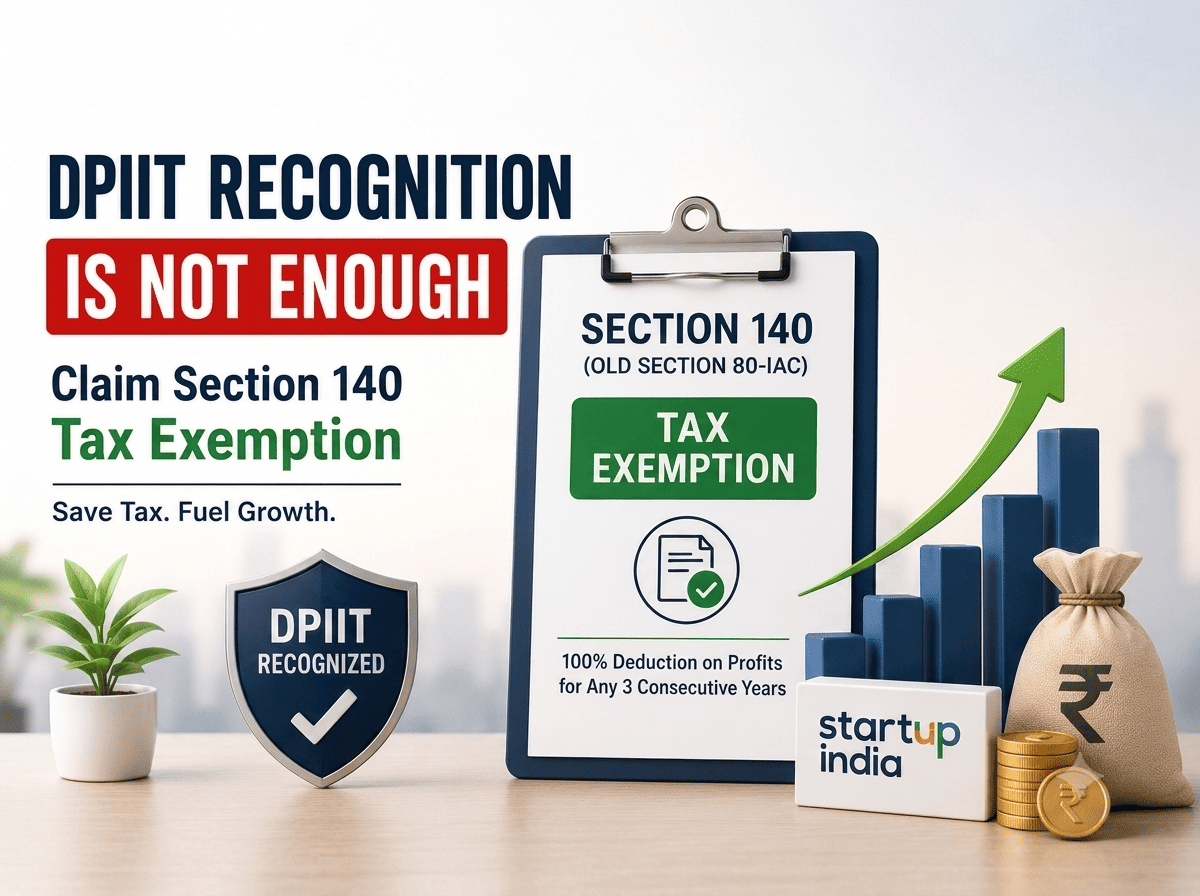
Getting DPIIT recognition feels like the finish line. It isn’t. Recognition is just the beginning.
Once recognized, your startup must meet several compliance conditions set by the Government of India:
- Obtain certification for tax benefits under Section 140 (Old Section 80-IAC)
- Comply with investment restrictions
- Use funds appropriately
- Ensure all information provided to the government is accurate
Failing to meet these conditions can result in cancellation of benefits or even revocation of recognition.
DPIIT Recognition vs Section 140 Tax Exemption: Not the Same Thing
Many founders assume DPIIT recognition automatically unlocks income tax benefits. It does not. To claim a startup tax deduction under Section 140 (Old Section 80-IAC) of the Income Tax Act 2025, you must apply for a separate certification from the Inter-Ministerial Board (IMB) through the Startup India Portal.
What Section 140 (Old Section 80-IAC) Tax Benefit Actually Gives You
- 100% deduction on profits from your eligible business
- Claimable for any 3 consecutive assessment years within the first 10 years from incorporation
- Can significantly reduce or completely eliminate your income tax liability for those years
- Lower tax outgo means more cash stays in the business for growth, hiring, and expansion
Who Qualifies: Eligible Startup Conditions
To qualify for the Section 140 tax deduction, your startup must meet all of the following:
- Incorporated as a Private Limited Company or LLP
- Incorporated on or after 1 April 2016 but before 1 April 2030
- Annual turnover not exceeding ₹300 crore in the year the deduction is claimed
- Holds a valid Certificate of Eligible Business issued by the IMB notified by the Central Government
What Counts as an Eligible Business Under Section 140?
The business must be engaged in:
- Innovation, development, or improvement of products, processes, or services
- A scalable business model with potential to create significant employment and wealth
Key Conditions to Claim the Startup Tax Deduction
Your startup must not have been formed by:
- Splitting or restructuring an already existing business
- Transferring plant or machinery previously used for any other purpose, unless the value of that old machinery does not exceed 20% of the total machinery value in the new business
Exception for Business Revival: If a business was destroyed or severely damaged due to a natural calamity, riot, civil disturbance, accidental fire, or war, and was later revived or re-established, it can still claim the deduction under Section 140 (Old Section 80-IAC).
How to Apply for Section 140 Tax Exemption: Step by Step
Step 1: Obtain DPIIT Recognition Log in to the Startup India Portal and complete the DPIIT recognition process first. You cannot apply for tax exemption without this.
Step 2: Apply for Tax Exemption on the Startup India Portal After recognition, select the “Claim Tax Exemption” option and provide:
- Name of the startup
- Date of incorporation
- Registered address and business location
- Incorporation or registration number
- Type of entity (Private Limited Company or LLP)
- DPIIT recognition number
- Email address, mobile number, and PAN of the entity
- Declaration of scalability: revenue has grown by more than 10% in one year, 25% over two years, or 33% over three years
Step 3: Upload Supporting Documents
All documents must be submitted in PDF format:
- LLP Deed (for LLPs) or Memorandum of Association or MOA (for Private Limited Companies)
- Board Resolution, if applicable
- CA-certified Balance Sheet and Profit & Loss Account
- Financial statements for the last 3 financial years or from the date of incorporation, whichever applies
- Income Tax Returns for the last 3 assessment years or from the date of incorporation, as applicable
- Startup pitch deck
- Link to the startup’s video pitch
Additional documents may be requested depending on the nature of the business.
Once submitted, the IMB (Inter-ministerial board) reviews the application. If approved, your startup receives the certificate needed to claim the income tax deduction under Section 140 (Old Section 80-IAC).
Why Startup Tax Compliance Matters
DPIIT recognition is only the first step in a startup’s compliance journey. To avail the tax benefits under Section 140 (Old Section 80-IAC), eligible startups must meet the prescribed conditions, obtain certification from the Inter-Ministerial Board (IMB), and comply with the applicable post-recognition requirements. Timely compliance not only helps startups claim valuable tax deductions but also ensures they continue to enjoy the benefits offered under the Startup India initiative while avoiding the risk of disqualification or withdrawal of recognition.


